Decatur Tree Removal Pros has been doing tree removal in Athens for more than twenty years, and the question homeowners here ask last is usually the one that should have been asked first: where is the wood going? The takedown is the part people picture when they call. The disposal is the part that puts hundreds of dollars between two quotes, and in Athens it is settled by a single clause in the city’s own collection policy.
That clause does not care how large your pile is. It cares who made it, and how that person was paid. A homeowner who spends a weekend cutting up a limbed-out maple ends up with brush the city will take. The identical pile, cut by someone who was handed the firewood in exchange for the labor, is refused — not because it grew somewhere else, but because of the arrangement behind it.
So we price debris as its own line and we say in writing whether haul-away is inside the number or outside it. Two decades of work across the Tennessee Valley — river bottomland, the Highland Rim uplands behind it, plateau ground to the south — has taught us that the disposal line is where a cheap quote hides.
The four cubic yards the city will take, and whose brush it has to be
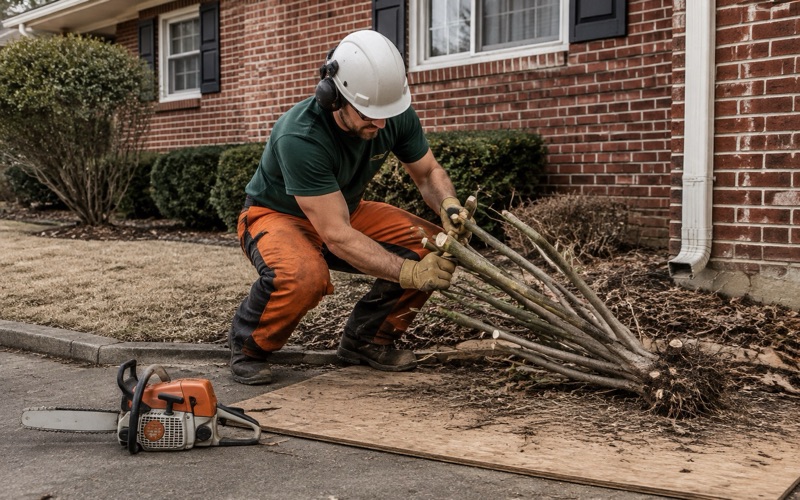
Athens runs a real residential brush service, and it is worth using. The city collects limbs and brush generated at the residence by the resident, limited to 4 cubic yards per week — the city puts that at approximately 12 feet long by 3 feet wide by 3 feet high — under section 46-97(c) of the 2009 Code of Ordinances. For a weekend of pruning with a pole saw, that is a generous allowance.
For a removal it is nowhere near the volume in play. The canopy on this side of the river is oak-hickory, sitting on the Eastern Highland Rim rather than the plateau escarpment, and one mature oak or hickory in a front yard puts more than four cubic yards on the ground during the limbing alone, well before the stem comes down. Measured against a 12-by-3-by-3 outline, an afternoon of work is several weeks of curbside collection.
A removal makes two piles, not one
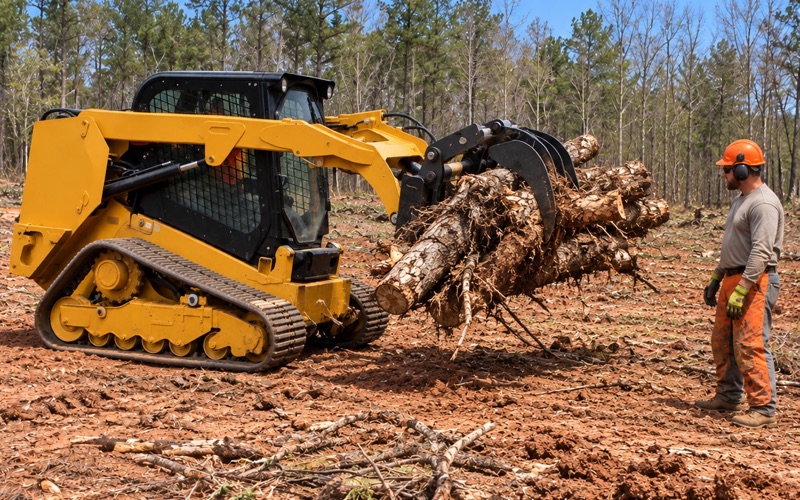
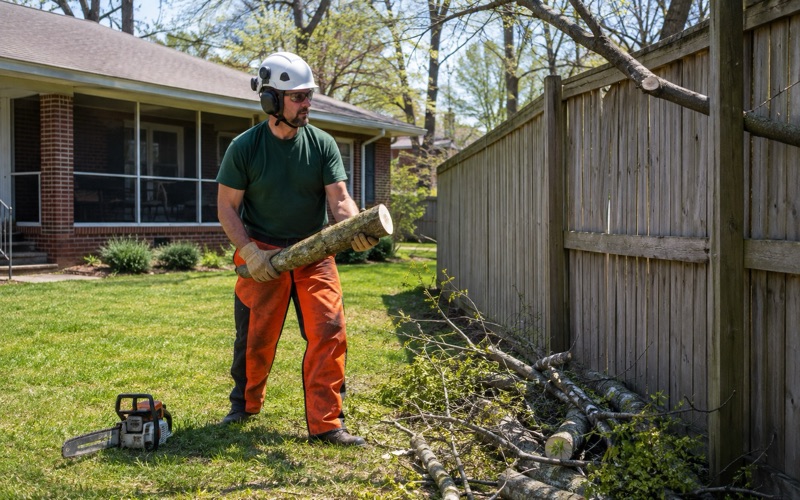
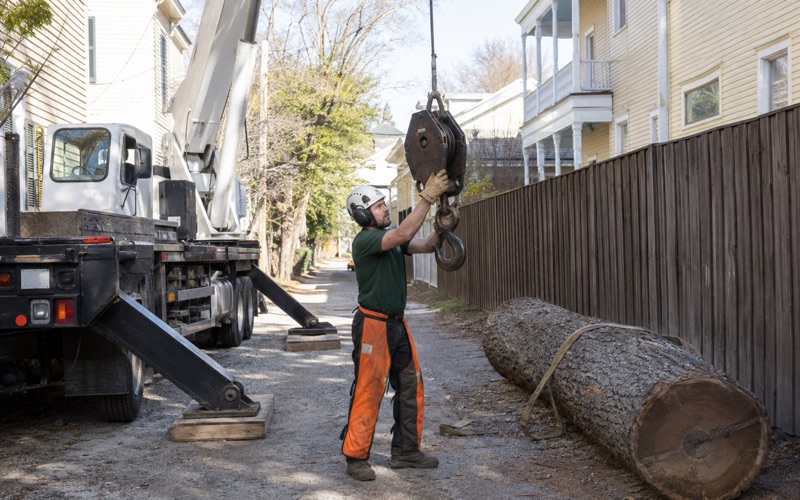
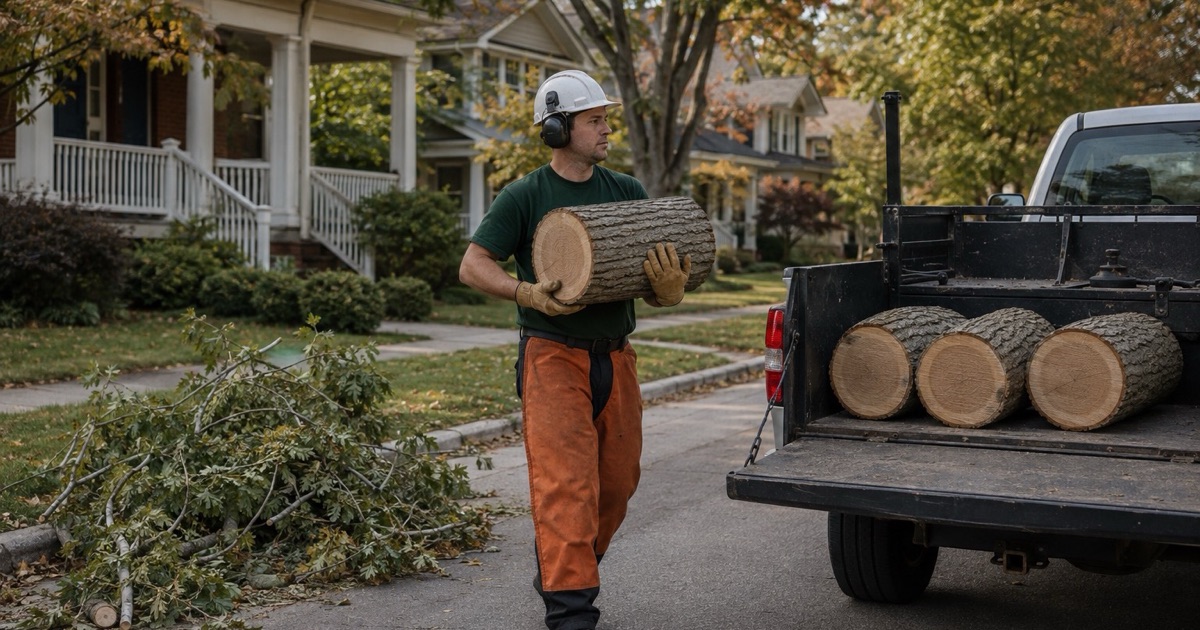
Brush is the smaller half of the problem. Sectional dismantling of a stem with a diameter at breast height of two feet or more leaves trunk rounds behind, and rounds are not brush. They will not pass a brush chipper feed roller, they do not compress into anything, and they move by hand or under a knuckleboom grapple truck. A pile that is half rounds is a pile no curbside program was ever designed around.
The volume is not the part that disqualifies you
Four cubic yards is the ceiling, and the ceiling is the number people remember. The words in front of it are the ones that decide the outcome: generated at the residence by the resident. Every limb in the stack can have grown in your own back yard and still be turned down, which is why this catches people. Nothing about the wood itself looks any different on collection morning.
Looking for tree-removal closer to Madison? See Tree-Removal in Madison.
Payment in material, and the deal that quietly reclassifies your pile
The exclusion is stated plainly in the city’s own answer: any work performed by a contractor, or by anyone paid or given material for work performed, will not be collected by the City. The second half of that sentence is the part worth reading twice. Payment in material counts as payment.
Athens therefore decides who is a contractor by what changed hands, not by whether an invoice was written, a business name was painted on a truck door, or money moved at all. There is no dollar threshold in the sentence, and no exemption for a small job or a one-tree favor.
The handshake that costs more than it saves
The version we run into most often goes like this: a man with a saw offers to take the tree down for free, as long as he can keep the wood. No invoice, no check, nothing on paper. To a homeowner watching estimates climb, it reads like the cheapest possible outcome and very nearly a gift.
Under the city’s wording, the wood is the fee. The person who cut the tree was given material for work performed, and everything left at the curb became contractor debris the moment that deal was struck — including the brush, which is usually the half he had no use for and left behind.
Same pile, different sentence
Nothing physical changes. Same species, same volume, same curb, same week. The only thing that moved is the description of how the cutter got paid, and that description is exactly what the collection policy tests.
The consequence also lands on the wrong person. He leaves with the marketable wood; the brush stays in the yard and now has to be hauled somewhere at somebody’s expense. We would rather quote that haul honestly at the start than let it turn up as a surprise after the crew is gone.
Six inches at the county gate, and where a trunk section really goes
Step outside the city program and the diameter limit takes over. Limestone County’s solid waste service accepts brush and logs six inches or less in diameter. Six inches is a limb. It is not a trunk section, and it is not the butt log of anything anybody bothers to remove — the stem diameter that makes a tree a removal candidate is routinely three to five times that.
So the material a removal actually produces falls into a gap. It is too much for a four-cubic-yard residential allowance, refused outright the moment somebody was paid in cash or cordwood, and thicker than the county gate will take. The published destination for what the city will not collect is the waste transfer station at 16100 BFI Lane, operated jointly by Limestone County, the City of Athens and BFI, at a stated nominal fee, with the instruction to call ahead and confirm the material is accepted. That is a truck, a driver and a round trip, and it belongs on an estimate as a number rather than a shrug.
Why the firewood credit is worth more here than on a Decatur job
We quote the firewood credit as a line on the estimate and we quote what it is genuinely worth on that job, rather than presenting it as a favor we are doing you. Its value is set by what disposal would have cost instead.
On a Decatur job, where the county gate takes yard debris free, the credit is worth the least it will ever be worth: we are being handed wood we could have gotten rid of for nothing anyway. On an Athens job the arithmetic inverts. Every round we keep is a round nobody pays to move, so usable hardwood comes off the debris line at a number we can defend.
That also means the credit is not a flat rate, and any crew quoting it as one is guessing. Sound hardwood in straight, splittable lengths where the truck can reach it is worth something real. A hollow, decayed stem, or good wood two hundred feet down a fenced back yard with no vehicle access, is worth close to nothing, and we say so rather than quietly pricing it as though it were.
Getting the disposal line written into the quote before the crew arrives
Every estimate we write separates the takedown, the stump and the debris into three priced lines, because those are the three numbers competing quotes disagree about. Put a low bid and a high bid side by side and the gap is almost always sitting in the third line — frequently because one of them left the debris out of the job altogether.
Haul-away is therefore stated on our quote in words: included, or not included. Nobody should have to infer it from a total. Where a curbside cap or a policy sentence about contractor debris changes what happens after we drive away, that goes on the same page, in advance, instead of being discovered on collection day.
Access is priced before the tree is
We measure the approach before we price the removal — gate width, the drop zone, the carry distance from the trunk to the truck, and where a chipper that will never fit through a back gate is actually going to sit. Athens has a great deal of established housing, with 38.4 percent of its units built before 1980, and mature canopy standing over fenced yards is exactly the situation where access rather than sawing sets the price.
The stump is its own number for a reason
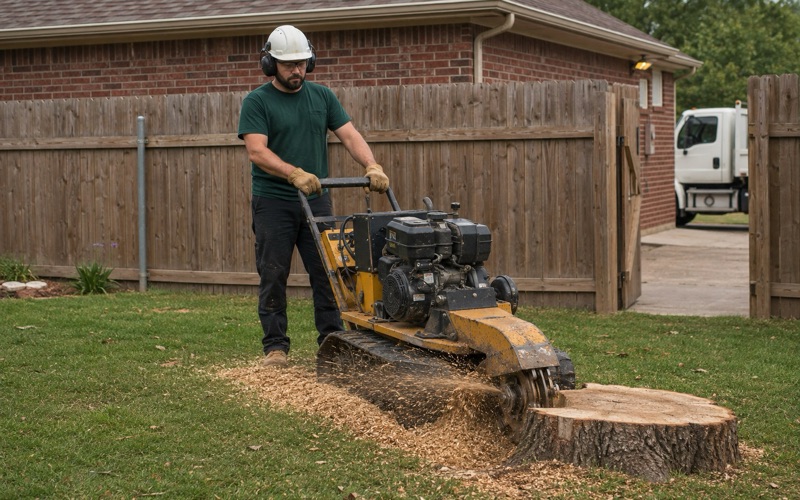
Stump grinding here is limited by the machine, not by rock. The dominant valley soils in Limestone County are the Decatur and Dewey series — the Decatur series is type-located in this county, near Greenbrier — and depth to limestone bedrock on both runs past 60 inches. What stops the cutting wheel is the grinder’s own rated grinding depth below grade, roughly 12 to 25 inches depending on the class of machine.
The exception is real enough that we will not promise a depth sight-unseen. The same ecoregion carries cedar glades on thin soil over shallow limestone, and in one of those pockets rock reaches the wheel first. Chert in the soil also wears carbide teeth faster than clean clay does, which is a cost we plan for rather than an excuse we produce afterward.
Storm work does not suspend any of this
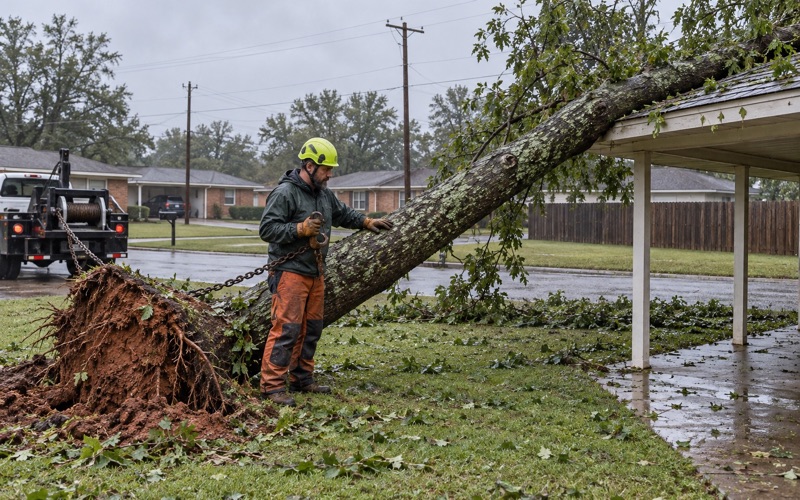
Storm damage creates no exception to the collection rule. An EF1 tornado damaged the Limestone County Courthouse downtown in December 2024, and a yard full of storm debris cut by a paid crew is still contractor debris under the same sentence that governs a scheduled job. We answer hazard calls the same day, and the debris question gets the same written answer either way.
- 20+ Years in the Tennessee Valley
- Free Written Estimates
- Same-Day Storm Response