Decatur Tree Removal Pros handles shrub removal, hedge removal and brush clearing across Decatur, AL, and it is a different trade from tree work even though the same crews do it. The wood is small, the volume is enormous, and the cost sits in the debris and the roots rather than in anything anybody would call cutting.
That is why the estimate splits it. Taking the plants out, taking the roots out, and getting the material off the property are three separate decisions with three separate prices, and a single number for a hedge hides which of the three you are actually buying. A cheap number almost always means the roots stay and the pile is somebody else’s problem.
The other thing worth saying up front is that municipal brush programs in this ring do not cover work a contractor did. Decatur requires contractors to haul their own debris and its Solid Waste Department will not collect it; Cullman’s rule is written the same way. So the disposal plan belongs on the estimate rather than at the curb.
What Comes Out, and How
Cut to Grade Against Full Root Removal
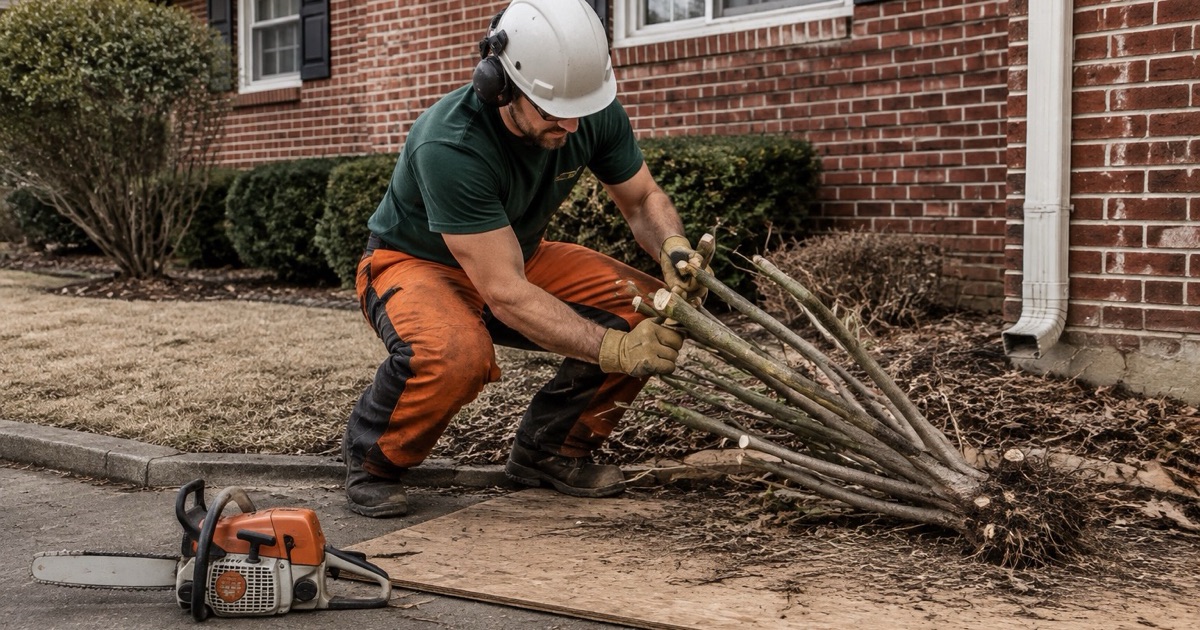
Cutting to grade drops the plant and leaves the root system, which is fast, cheap, and fine where a slab, a bed or a fence is going over it. It is also how privet, ligustrum, nandina and half the old foundation planting in this town come straight back the following spring. Full removal takes the root ball, leaves a hole to backfill, and costs several times as much for exactly that reason.
Old Foundation Shrubs and What Is Underneath
A shrub planted against a house in the 1970s has had fifty years to build a root ball, and it is usually growing through a footing drain, an irrigation line, a downspout run or all three. Those come out slowly and by hand, with locates in place, because the expensive part of the job is not the plant — it is whatever is buried beside it that nobody knew was there.
Machine Work Against Hand Work
An open fence line or a boundary hedge with room beside it is machine work and prices accordingly. A courtyard, a bed against the foundation, a slope, or anything over irrigation and low-voltage lighting is hand work, and no amount of wanting it to be otherwise changes that. We measure the access on the estimate visit and quote the method that is actually going to be used.
The Jobs This Usually Is
Overgrown Foundation Plantings
The most common call is a planting that outgrew the house it was put in front of: shrubs over the windows, against the siding, holding moisture on a wall, and hiding a good part of the elevation. Removal is straightforward; the decision worth making at the same time is whether anything goes back in, because the same species at the same spacing produces the same result in fifteen years.
Dead and Diseased Screens
A privacy screen that is dying in sections is usually a spacing problem that turned into a disease problem. Seiridium canker on Leyland cypress is the local version, and once brown flagging is moving along a row the plants that are gone are gone. The question is whether the remainder is worth keeping as a partial screen or whether the row comes out and gets replanted properly.
Fence Lines, Boundaries and Brush
An untouched fence line collects privet, honeysuckle, volunteer sweetgum and briar in a band that eventually takes the fence with it. Clearing it is mostly a debris exercise, and the two things that matter are where the property line actually runs and whether the fence is coming out with the brush. Both get established before a machine or a saw starts.
Debris — the Half Nobody Quotes
Volume, Not Weight
Shrub and brush work generates far more volume per dollar of cutting than tree work does, and volume is what fills trucks. A hedge that took two hours to cut can take most of a day to remove, which is exactly why a quote that treats debris as an afterthought is the one that ends with a pile beside the driveway.
Curbside Limits, City by City
What a homeowner may set out varies across this ring and none of it covers contractor work. Decatur takes homeowner limbs under 12 feet long and 12 inches thick, with bulk pickup unscheduled and roughly two weeks out. Cullman meters it harder — 3 cubic yards per stop, limbs under 6 feet, stumps and tree parts under 75 pounds, placed within 5 feet of the curb. Both refuse debris from paid work outright.
Chipping, Hauling and the Landfill Gate
Brush can be chipped and left as mulch, chipped and hauled, or loaded whole. Hauling ends at a gate with a rate attached: the Morgan County Regional Landfill at Trinity takes this material at 30 dollars per ton with a 16 dollar minimum. Knowing which of those three the estimate covers is the difference between a finished job and a tidy pile you now own.
After the Shrubs Are Gone
Replant, Hardscape or Leave It Open
The ground that appears when a foundation planting comes out is usually the first time anyone has seen it in decades, and it is worth deciding what happens next before the crew leaves. Replanting smaller species at honest spacing, extending turf, or laying a bed with mulch are all cheaper to do while the equipment is on site than as a second visit next season.
Grade, Soil and the Holes Left Behind
Full root removal leaves holes, and holes filled level on the day settle into depressions within months. Backfill gets mounded to allow for it, and it is soil rather than chips, for the same reason grind spoil makes poor fill. Where a bed is going back, that is also the moment to fix a grade that has been running water at the foundation for years.
- 20+ Years in the Tennessee Valley
- Free Written Estimates
- Same-Day Storm Response