Decatur Tree Removal Pros has done tree trimming and pruning in Decatur, AL for 20+ years, serving surrounding cities including Hartselle, Triana, Athens, Madison, Huntsville. Pruning is where a tree service either earns a tree another forty years or quietly costs it twenty, and the difference is almost entirely in which cuts get made and where they are placed.
Every quote names the operation rather than the word. Crown cleaning, crown raising, crown reduction and crown thinning are four different jobs with four different outcomes and four different prices, and the tree care industry standard, ANSI A300, separates them for exactly that reason. A quote that says trimming and gives a number has not told you what will be missing when the crew leaves.
The other half of this page is the work that keeps a tree instead of removing it. Cabling and bracing, structural pruning on young trees, and lightning protection on a specimen worth protecting are all real alternatives to a stump, and they are unusually thin on the ground in this market. If a tree can be supported rather than taken down, that option belongs on the estimate next to the removal price.
The Four Pruning Operations, Named
Crown Cleaning: Deadwood and Broken Limbs
Cleaning removes what is already dead, dying, broken or crossing, and takes nothing that is doing the tree any good. It is the lowest-risk pruning there is and the one most often worth doing on a mature hardwood over a house, because the material it removes is the material most likely to come down on its own. On a large tree it is also the visit where defects get spotted from inside the canopy rather than from the driveway.
Crown Raising for Clearance
Raising lifts the lower canopy off a roof, a driveway, a walkway or a sight line. The constraint is that lower limbs are doing a disproportionate share of the work of building trunk taper, so raising a young tree too far too fast produces a tall stem with a small crown and poor structure. Done properly it is a gradual operation across visits rather than one dramatic afternoon with everything below head height gone.
Crown Reduction and Thinning
Reduction shortens limbs back to a lateral large enough to take over as the new leader, which is what makes it different from topping. Thinning removes selected branches through the canopy to let light and wind pass, and it is easy to overdo — stripping the interior and leaving foliage only at the ends produces exactly the lion-tailed limbs that break. Both operations are quoted with a stated proportion of live crown, not as an instruction to open it up.
Topping, Tipping and Why We Will Not Do It
What a Heading Cut Actually Does
Topping cuts stems back to a stub with no lateral able to assume the lead. The cut face has no way to seal properly, so decay works inward down the stub and into the parent stem, and a decay column builds where the tree used to have solid wood. The city’s own arboricultural position treats this as damage rather than maintenance, and that is the mainstream view across the trade.
Epicormic Sprouts and the Second Failure
The tree answers a topping cut with a burst of epicormic sprouts around the wound. They grow quickly, they are anchored in bark rather than seated in wood, and within a few seasons they form a crown that is taller and heavier than what was cut off, sitting on top of a decaying stub. The failure this produces is worse than the one the topping was meant to prevent, and it arrives later, when nobody connects the two.
The Reduction You Actually Wanted
Almost every topping request is a height or a clearance request. Reduction cuts made back to an adequate lateral get most of that height, keep a defensible structure, and leave a tree that looks like a tree afterward. Where the reduction needed is more than the species will tolerate, the honest answer is that this tree is in the wrong place, and removal and replanting is the cheaper decision over ten years.
Cabling, Bracing and Tree Support Systems
Static and Dynamic Cabling Systems
A cable installed high in the canopy limits how far two stems can move apart in wind without holding them rigid. Static systems use steel and are sized to a working load limit; dynamic systems use synthetic rope with some designed stretch so the tree keeps enough movement to build reaction wood. Either way the hardware is a support, not a repair, and it is installed with an inspection interval rather than fitted and forgotten.
Threaded Steel Bracing Rods
Where a union has already split, a cable alone is not enough — the two halves need to be held together through the wood. Threaded rods installed through the union do that, usually in combination with a cable above. The wood around the union has to be sound for a rod to hold, which is why bracing is quoted after the union has been inspected rather than from a photograph on the phone.
Lightning Protection for Specimen Trees
A lightning protection system for a tree is a copper conductor run from the upper crown to a ground rod clear of the root zone, and it is installed on the trees whose loss would actually matter — the tall specimen close to the house, the historic tree on a public site. Tulip poplar comes up in this conversation here more often than any other species, because it grows taller than everything around it.
Structure, Species and Clearance in the Tennessee Valley
Structural Pruning on Young Trees
The cheapest pruning anybody ever buys is done in the first fifteen years. Selecting a single leader, spacing scaffold limbs and removing competing co-dominant stems before they trap bark in the union prevents the exact defect that later costs a cable, a brace or the tree. On the deep valley soils here, where hardwoods hold their footing and fail at unions instead, that early work is worth more than it looks.
Species, Timing and What Grows Here
This is oak-hickory country, with cedar glades on the shallow soils over limestone, and the species mix drives the calendar. Dormant-season work makes structure visible and is the easiest time to reduce or thin most hardwoods; pines are read for pitch tubes and boring dust before anyone decides pruning is the answer; a Leyland cypress screen planted so the crowns touch is a canker problem rather than a pruning problem. The estimate says which of those the tree is.
Clearance From Conductors and the Service Drop
Line clearance on a utility’s own conductors is the utility’s work, done by its own crews and its own contractors. What we do is establish which wire is in question before quoting anything near it. Around Decatur that is Decatur Utilities, reachable at 256-552-1400; elsewhere in the ring the service drop between the pole and the house is treated differently, and no crew works inside the electrical-hazard limits of ANSI Z133 regardless of who owns the wire.
Our Step-by-Step Tree Trimming Process
Step 1: Walk the Tree and Name the Operation
The visit starts with what is bothering you and ends with an operation written on the estimate — clean, raise, reduce, thin, or a stated combination with the proportion of live crown involved. Defects seen from the ground get noted at the same time, because a union with included bark changes what the pruning should try to achieve.
Step 2: Set the Access and the Rigging Plan
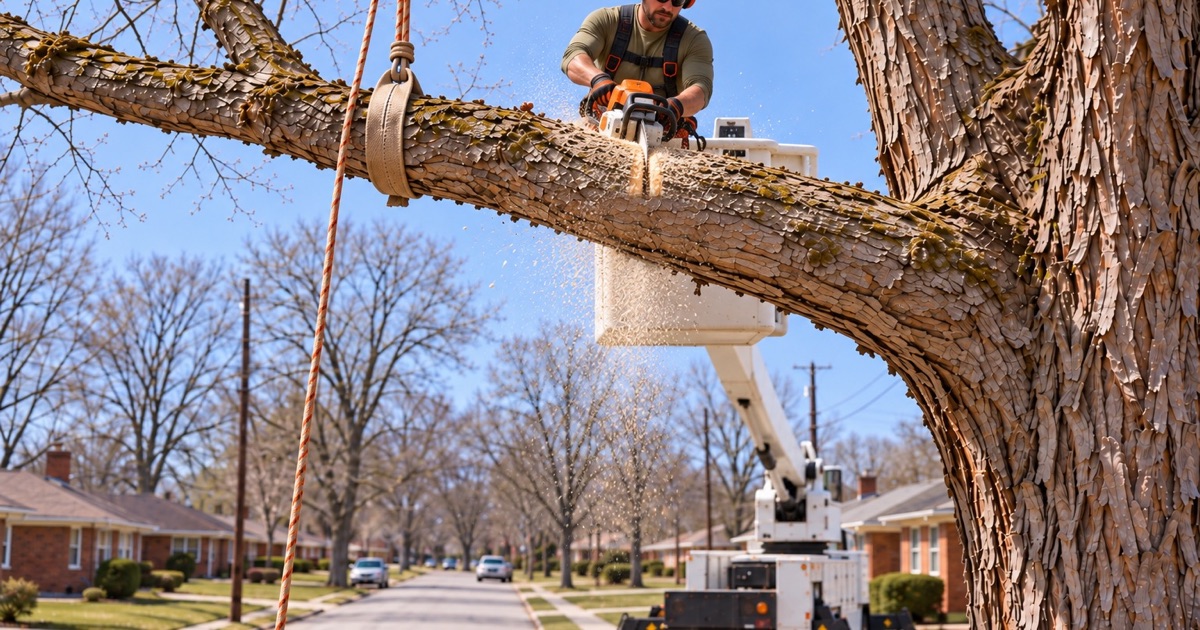
How the crew gets into the tree and how the wood gets out decide most of the price. A climbing saddle and a rope, an aerial bucket truck, or a tracked spider lift into a back yard are three different days, and the limbs coming out over a roof or a fence need rigging with a bull rope, a block and a Port-a-Wrap rather than being dropped.
Step 3: Prune to the Standard
Cuts are placed at the branch collar without stubs and without flush cuts into the parent stem, reduction cuts go back to a lateral large enough to take the lead, and nothing gets removed that the operation on the estimate did not cover. If something inside the canopy changes the recommendation — decay at a union, a crack the ground view missed — you get told before the cut, not after.
Step 4: Clean Down and Say Where the Brush Went
Brush is chipped and hauled, or chipped and left as mulch, exactly as the estimate said. Hard surfaces get blown off, the drop zone is raked, and nothing is left at the curb on the assumption that the city will take it, because in Decatur it will not.
- 20+ Years in the Tennessee Valley
- Free Written Estimates
- Same-Day Storm Response