
Decatur Tree Removal Pros has done land clearing in Decatur, AL for 20+ years, serving surrounding cities including Hartselle, Triana, Athens, Madison, Huntsville. Lot clearing before a build, fence lines nobody has touched in a decade, pasture going back to sweetgum and privet, and opening a view from a house are all the same trade and four different jobs, and the machine that suits one is wrong for the next.
Clearing is priced on what is standing and what has to be left behind, never on acreage alone. Stem density and stem size, slope, how wet the ground stays, whether the roots come out or stay in, and where the material ends up are the five things that actually move the number. An acreage price quoted before anyone walks the ground is a guess that gets corrected later, usually upward.
The ground itself changes across a short drive here. The bottomland at the river holds moisture and carries a different stem mix from the deep residual clay of the uplands behind it, and the plateau ground south of the valley is different again. Machine choice, working season and what the finished surface looks like all follow from which of those a site sits on.
Forestry Mulching, Grubbing and Haul-Off
What a Forestry Mulcher Leaves
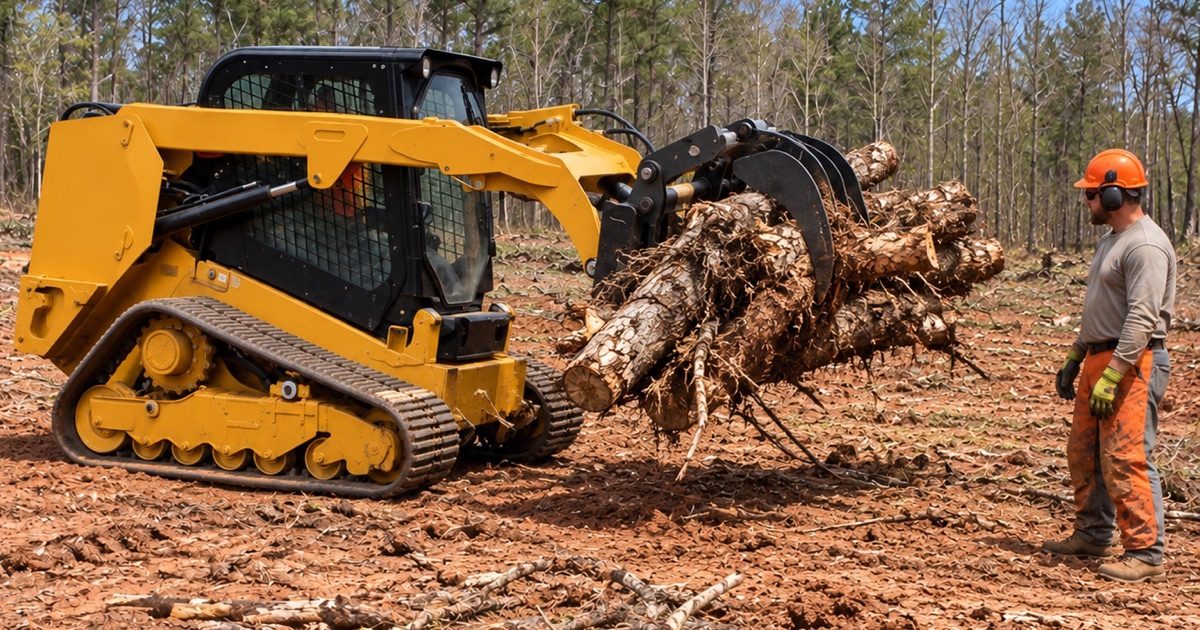
A mulching head grinds standing brush and small stems in place and spreads the material as a chip layer over the ground. The root mass stays where it is, so the surface is intact, there is no spoil to haul and no hole to fill — which is why mulching finishes ground in a day that full clearing would take a week to produce. It is the right answer for recreational land, pasture, fence lines and view work, and the wrong answer under a foundation.
Root Grubbing and Full Clearing
Where the ground has to carry a building pad, a driveway or graded lot, the roots come out. Grubbing pulls root masses and stumps, which leaves holes, spoil and a surface that has to be graded and seeded before it is anything. It costs multiples of mulching and takes multiples of the time, and the only honest reason to buy it is that something is going to be built on the result.
Cut-and-Haul, Chipping and Disposal
The third method is conventional felling with the material leaving the site: mature stems bucked and trucked, brush through a chipper, and the chip either spread or hauled. It is the choice when the wood has value, when the material cannot be left on the ground, or when a site is too tight for a mulcher to work. Disposal cost is a real part of that number, and it is quoted as its own line.
What Gets Cleared, and Why
Lot Clearing Before a Build
A build lot needs bare, gradable ground and it needs the trees that are staying to actually survive the process. Those two goals fight each other, because the machines that clear the lot are the machines that compact and cut roots under the trees you meant to keep. Deciding which trees stay before clearing starts — and fencing their root zones before the first machine arrives — is what makes the difference between a kept tree and a dead one three years later.
Fence Lines, Pasture and Reclaimed Ground
An overgrown fence line is a mulching job with a boundary problem attached, and reclaimed pasture is a mulching job with a follow-up problem attached. Sweetgum, privet, honeysuckle and volunteer pine come straight back from root and seed after a single pass, so the realistic plan is one clearing pass plus a maintenance answer — grazing, mowing or a second visit — rather than a one-time cure sold as one.
Opening a View and Selective Clearing
View work is the most delicate clearing there is, because the point is what stays rather than what goes. Taking the understory and a small number of selected stems usually gets more view than a broad clearing does, and it leaves the canopy that holds the soil and keeps the yard cool. Selective clearing is walked and marked with the owner standing at the window that matters, not planned from a property map.
Ground, Access and Timing in the Tennessee Valley
Bottomland, Uplands and Plateau Ground
The river bottoms hold water and carry a bottomland hardwood mix; the uplands behind them are deep, well-drained residual clay over limestone; the plateau ground to the south is different from both. Each one has a season it works best in and a machine it suits, and pricing a job on one as though it were the other is how a schedule slips a week for weather that was entirely predictable.
Slope, Wet Ground and Machine Choice
Tracked machines float where wheeled machines rut, and a rutted field is damage that outlives the clearing. On slopes the limit is the machine’s stability rather than its power, and on wet ground the limit is what the surface will carry. We say which machine is going on the site and what the ground needs to be like for it to work — including that some jobs are better bought in a dry month than at any price in a wet one.
Locates, Boundaries and Buried Surprises
An Alabama 811 notice goes in before any ground-engaging work, and on rural parcels the private lines are the ones that bite: water to a barn, power to a well or a shop, an old septic field, a buried loop nobody remembers. Boundaries get the same treatment. Where the property line is not certain, we work back from it and mark a buffer rather than clearing to what looks like the edge.
Disposal, Shoreline and Development Rules
Debris Volume and Where It Goes
Clearing generates more material than any other tree work, and the disposal plan is a large share of the price. Material can be mulched in place, windrowed, chipped and hauled, or trucked whole. The Morgan County Regional Landfill at Trinity takes limbs, stumps and construction and demolition debris at 30 dollars per ton with a 16 dollar minimum, and that gate rate is what a haul-off line is built from rather than a round number.
Shoreline and Refuge-Adjacent Ground
Work on a Wheeler Lake bank is federal ground before it is a clearing job. The Tennessee Valley Authority administers a Section 26a approval and a shoreline management zone along the reservoir, and parcels adjoining the national wildlife refuge carry their own considerations. Both belong in the schedule at the estimate — an approval discovered mid-job is a stopped machine and a bill that keeps running.
Development Sites and Landscape Plans
A finished residential lot in Decatur carries no tree removal permit; the zoning ordinance has no tree preservation article and no tree permit section anywhere in it. Development sites are governed instead through the landscaping and buffer standards in the Development Standards article, working from a landscape plan. Knowing which of those two situations a parcel is in changes the sequence of the job, and it is settled before clearing starts.
Our Step-by-Step Land Clearing Process
Step 1: Walk the Ground and Define the Result
We walk the parcel with you and write down what the finished ground has to be: mulched and walkable, mowable pasture, a gradable build pad, or a selectively opened view. Stem density and size, slope, wet areas, boundaries and the trees that are staying all get recorded on that visit, because every one of them prices the job.
Step 2: Mark What Stays and Protect It
Keeper trees are marked and their root zones fenced before machines arrive, not after. On a build site that fencing is the whole difference between a mature tree that survives construction and one that dies quietly two summers later, when nobody is still connecting it to the clearing.
Step 3: Clear by the Method Quoted
Mulching, grubbing or cut-and-haul proceeds as the estimate described it, with the material handled the way it said. If the ground turns out different from what the walk showed — rock, a wet seam, buried debris, a boundary that does not match the fence — the machine stops and you get a call before anything else happens.
Step 4: Finish the Surface and Account for the Material
The last pass is about what you are left standing on: chip spread to a stated depth, spoil graded, holes filled, and any haul-off accounted for. Nothing is left at a curb for a municipal crew to collect, because contractor debris is refused across this ring and a pile at the road is simply a pile at the road.
- 20+ Years in the Tennessee Valley
- Free Written Estimates
- Same-Day Storm Response