Decatur Tree Removal Pros has been doing tree removal in Hartselle for more than twenty years, and on a fair number of those calls the most useful sentence we said was that the homeowner might not need to hire anybody at all.
That is not modesty. The electric utility serving inside the city limits publishes a policy most companies in this trade would rather you never read, and where a tree qualifies under it, the removal costs nothing. We would rather lose that one tree and keep the rest of the yard than quote a price against an offer we know is already sitting there.
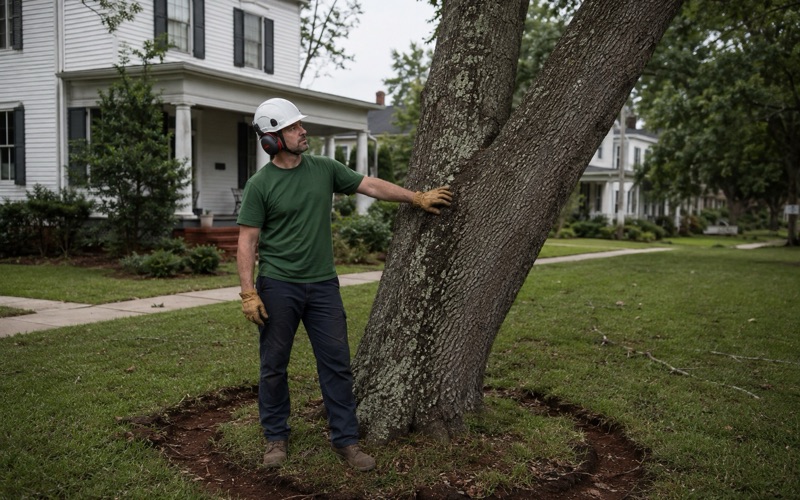
So an estimate here starts by sorting the lot into the trees the utility will deal with and the trees that are ours: the water oak leaning over the driveway, the hackberry against the back fence, the pine standing over a bedroom roof. Whatever is left gets priced in three lines, the takedown, the stump and the debris. Those are the three numbers competing quotes disagree about, and separating them is the only way to compare two of them honestly.
The line tree Hartselle Utilities will take down for you, and how to ask
Hartselle Utilities is not the City of Hartselle. It is a legally separate entity, and the city’s own development guide says exactly that, providing electric, water, wastewater, gas and garbage service within the city limits. It was incorporated in 1962, serves more than 5,400 business and residential customers over more than 70 miles of line, and is one of TVA’s local power companies. The distinction matters before the first phone call, because the city and the utility answer different questions and only one of them owns the conductors.
The policy itself is short and it is published: if you have a tree in your yard that needs to be pruned repeatedly to keep it away from power lines, HU will cut it down for you at no charge. The way to ask is to call Customer Service at 256-773-3340 and request that the tree be removed.
Making the request
Describe the tree by its relationship to the line rather than by species. How many times has it been cut back, and by whom? Which conductors does it reach as it grows out, the ones crossing the yard or the ones along the street? A tree that has been trimmed in successive cycles is the exact case the policy was written for.
The work then happens on the utility’s schedule with the utility’s own crews, and that is the one real trade-off. A free removal is not a scheduled removal, so a tree you need gone before a closing date or a roof replacement may still be a job you hire out. It is worth making that call on purpose rather than by default.
What the utility is already doing without being asked
HU runs a system-wide plan to monitor and trim trees and remove brush within ten feet of its power lines, and when trees on a property near those lines are likely to be trimmed, it notifies the customer first with a bright orange door hanger. It also asks for six feet of clearance around its equipment for landscaping, fencing, shrubbery and other obstructions.
Two things follow from that. A tree you have been worrying about may already be on somebody’s list. And shrubs planted tight against a pad or a meter are a separate problem from the tree, one you can fix yourself in an afternoon.
Looking for tree-removal closer to Triana? See Tree-Removal Services in Triana.
Which trees that offer reaches, and which ones it does not
The offer is narrower than it sounds on a first reading, and stretching it wastes a phone call. It covers the tree whose problem is the line, the one that keeps growing back into the conductors no matter how it is cut. It is not a general removal service for anything dead, leaning, hollow or simply too close to the house, and it is not a way to get a shade tree taken out because the leaves are inconvenient.
Distance to the line is the test
HU’s own planting guidance is the clearest way to judge which side of that boundary a tree sits on. Within 30 feet of power lines the utility advises choosing a tree with a mature height of less than 20 feet, and a tree with a mature height over 40 feet should be planted at least 60 feet away from power lines. Read backwards, those two numbers describe exactly the trees that become repeat-pruning cases: a species that wants to be sixty feet tall, put twenty feet from a conductor, thirty years ago.
Inside the city limits, and outside them
All of this applies inside the city limits, where HU is the provider. Rural Morgan County around town is served by an electric cooperative with its own members, its own vegetation policies and its own emergency number, and nothing described here should be read as theirs.
Triage follows the same line on the map. Inside the city, a downed or arcing conductor, or a tree lying on a primary line, goes to Hartselle Utilities at 256-773-3340, which is the after-hours and emergency number as well. Life safety and fire are 911. A tree blocking a public street or a right-of-way is the City of Hartselle at 256-773-2535. The service drop between the pole and the weatherhead is the question we hear most often, and the utilities around this ring answer it three different ways, so we ask about your specific address before the day of the job rather than assuming.
The rest of the lot: the back yard, the driveway, the one over the roof
Once the line trees are accounted for, what remains is ordinary work done in an old-house town. Of the 6,509 housing units here, 47.5 percent were built before 1980 and 79.7 percent are one-unit detached homes. A tree planted beside a house in the 1970s has had time to become the largest object on the property, usually with a fence, a driveway and a garage built around it since.
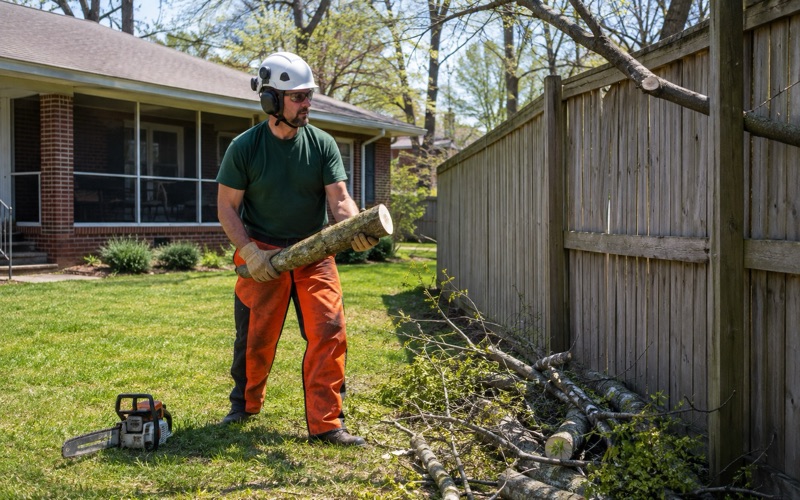
So we measure access before we price the tree: gate width, the drop zone, the carry distance from the trunk to the truck, and where a chipper that will never fit through any gate is actually going to sit. A quote written without those four measurements is a guess, and it is usually revised upward on the morning of the job.
Roofs, fences and narrow yards
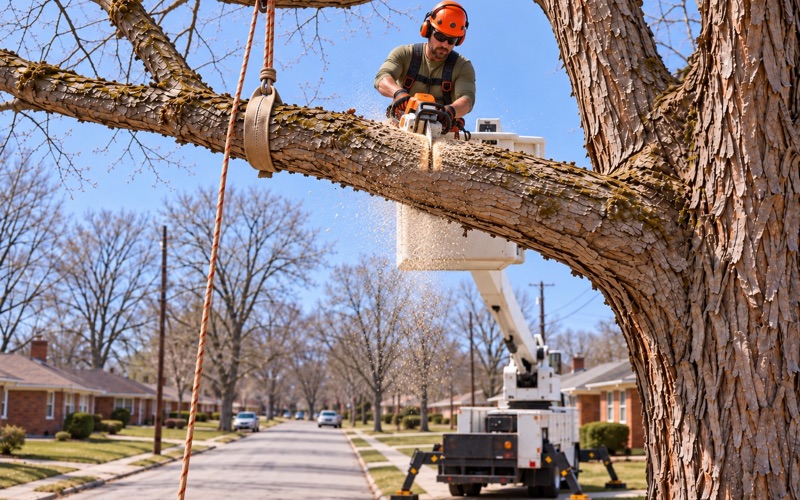
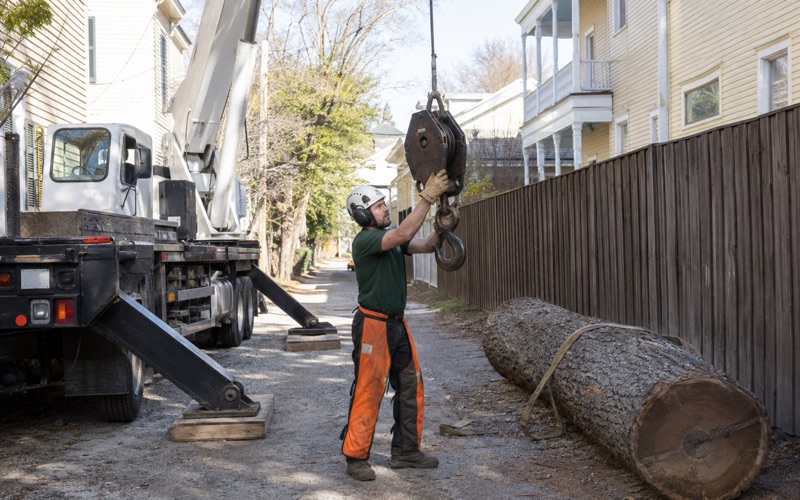
A tree standing over a roof gets crane or tracked-lift work and sectional dismantling, with pieces roped down through a rigging block on a bull rope and a friction device rather than dropped. A fenced back yard gets a narrow-access machine sized to the opening you actually have. We quote on the equipment that will fit, not the one in the brochure, because the alternative is a crew standing at your gate deciding whether to take a panel out of your fence.
Stumps and storm calls
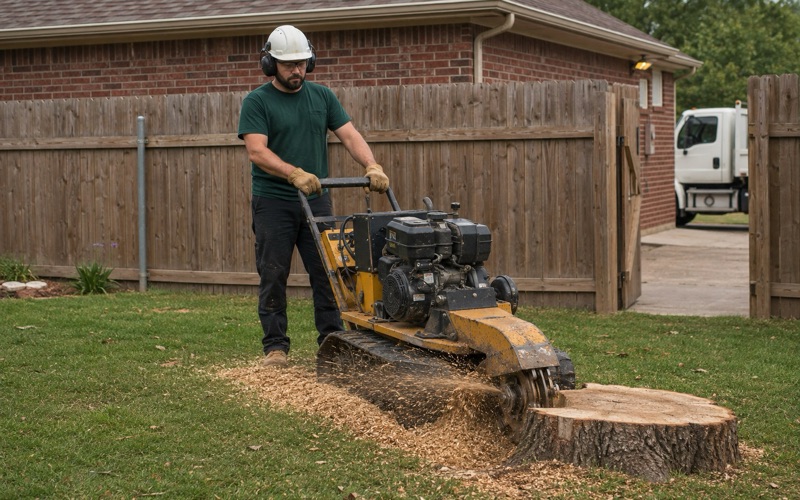
The stump is its own line on the estimate, with the finished grade and the above-grade cutting height agreed before the wheel turns and an Alabama 811 notice filed first. That notice requirement reaches stump grinding and root excavation, not only digging a footing, and a locate technician marks underground utilities within 48 hours.
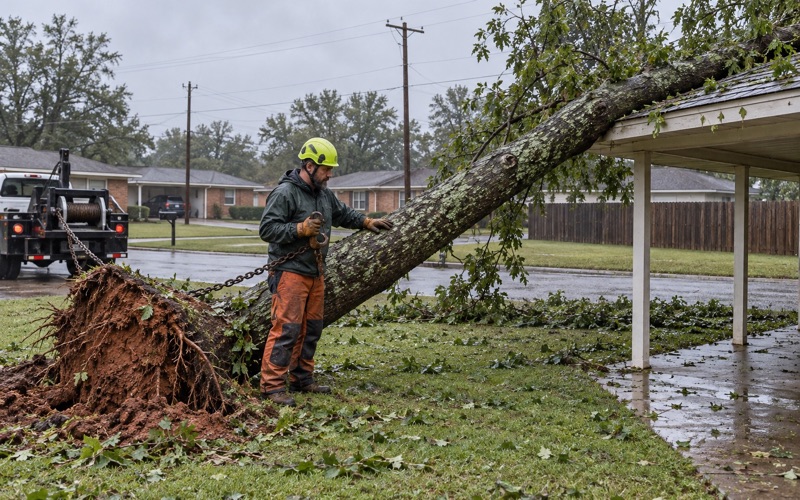
Storm and hazard calls are answered the same day, with one limit stated up front: the ANSI Z133 safety requirements for arboricultural operations put plain restrictions on working near energized conductors during high wind, ice and thunderstorms. A company promising a bucket in the air mid-storm is promising something nobody should deliver.
One thing worth knowing before you plan around a permit. The city’s Development Guide 2025 publishes the complete schedule of development fees Hartselle charges, and no tree, vegetation, land-disturbance or clearing permit appears anywhere on it. Full site plans are not required for single-family residential dwellings either; a simplified plot plan is reviewed at building permit.
What the wood costs once it is on the ground
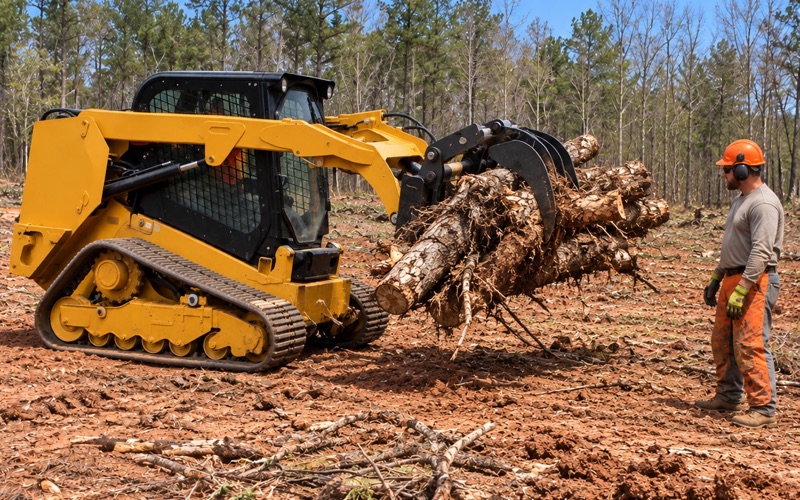
The Hartselle City Landfill at 99 Lovelady Street NW takes residential dumping free of charge, Monday through Friday from 7:30 a.m. to 4:00 p.m. and Saturday from 8:00 a.m. to noon. For a business or contractor it is 30 dollars per ton for yard waste and 62 dollars per ton for junk waste, each with a 5 dollar minimum. The same wood, from the same tree in the same yard, is free to the homeowner who hauls it and billed by weight to the crew that cut it.
That is why our estimate states haul-away in words, included or not included, instead of burying it inside a single figure. It is also why the firewood credit gets quoted plainly rather than offered as a favor: rounds left stacked on your property are tonnage that never crosses a scale.
The gate only opens for Hartselle wood
The landfill is only allowed to accept waste that comes from within the city limits of Hartselle. On a city address that is straightforward. For a property a mile outside the line there is no city disposal route at all, and the debris line on the estimate has to carry a longer haul to somewhere that will take the load. It is the most common reason two quotes on two similar trees a few miles apart are not the same price.
Curbside is for your limbs, not our brush
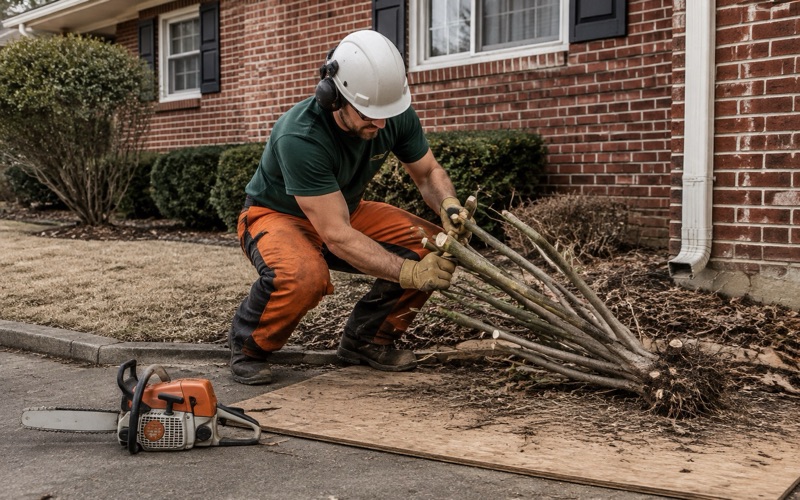
City yard waste collection takes residential limbs at the curb, metered rather than refused: 20 cubic yards at one time, with anything beyond that charged at 100 dollars per additional 20 cubic yards, and limbs cut to no more than five feet in length. What the city will not collect is waste produced by a contractor, and the policy names this trade directly, including contractors who cut down trees for residents and businesses.
We would rather you read that sentence on our estimate than discover it on collection day, standing beside a brush pile that is not going anywhere.
- 20+ Years in the Tennessee Valley
- Free Written Estimates
- Same-Day Storm Response