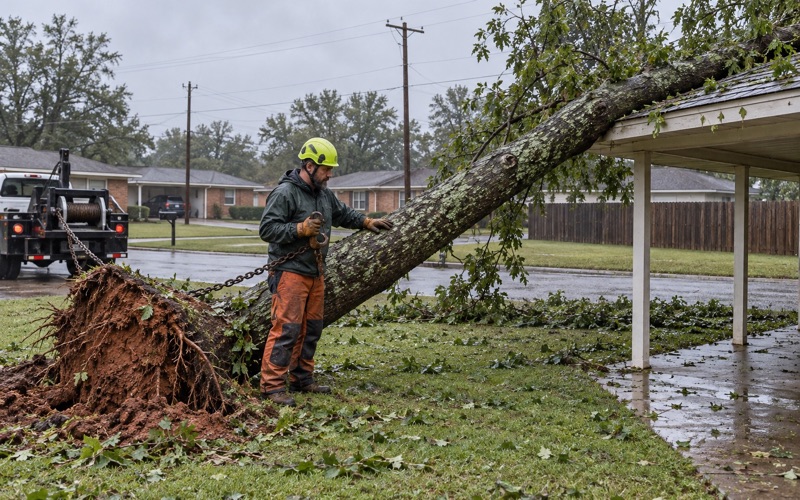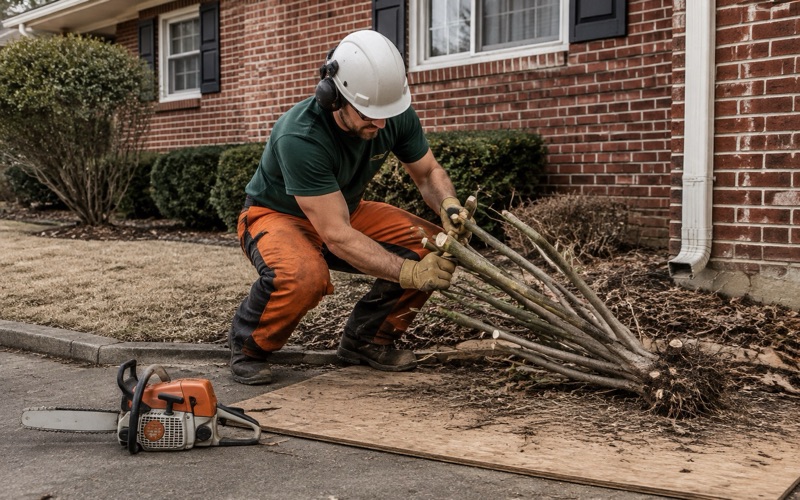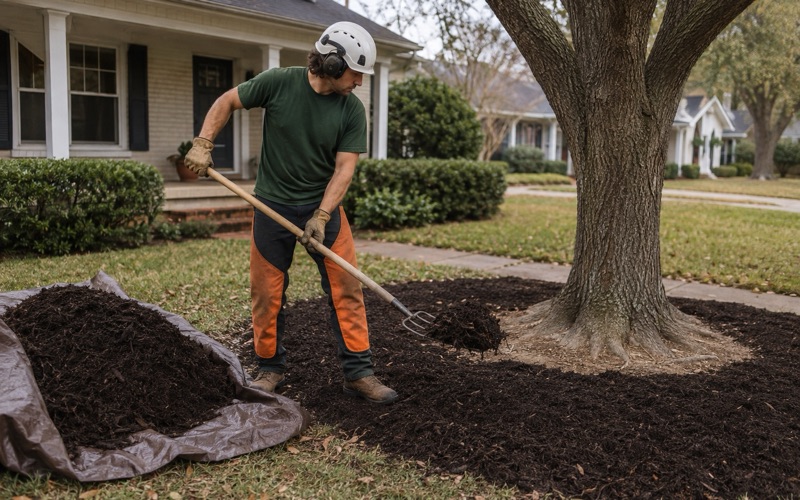
Decatur Tree Removal Pros has handled tree removal in Harvest for more than twenty years, and on a lot here the first question our crew asks is not about the tree. It is what the ground under the tree is actually made of.
Two decades of work in the Tennessee Valley have put our crews on three genuinely different kinds of ground: the Wheeler Lake bottomland down at the river, the Highland Rim uplands behind it, and the plateau ground south toward Brindley Mountain. Harvest sits on the Rim. What a stump grinder and a root plate actually meet on most lots here, though, is not Rim soil at all, but material a grading contractor put in place within the last thirty years.
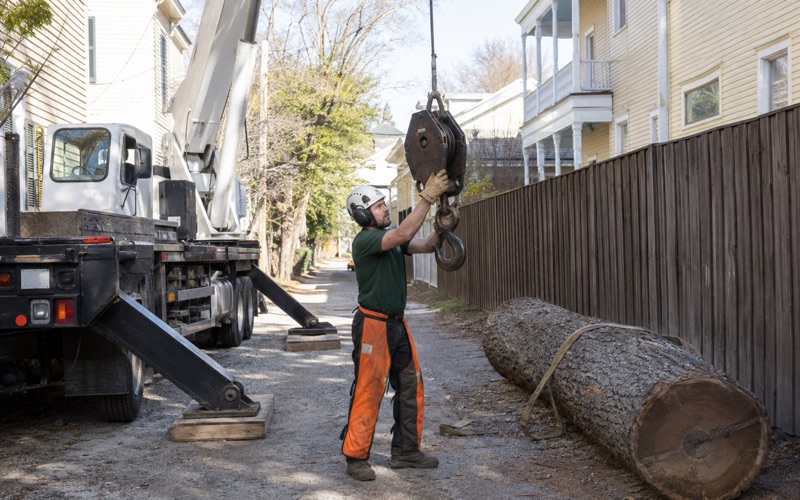
That distinction decides how the job is priced and how long it takes. We separate the takedown, the stump and the debris into three lines on the estimate, because those are the three numbers competing quotes disagree about. We also measure access first, before the tree is priced at all: gate width, drop zone, carry distance to the truck, and where a chipper that will never fit through any gate is going to sit.
The soil map and the graded lot are not describing the same ground
Harvest falls in the Limestone Valleys and Uplands soil area, formed mainly in residuum weathered from limestone, with Decatur and Dewey the extensive series through the valleys. Both are deep soils. The Decatur series carries a solum more than 72 inches thick with limestone bedrock deeper than 6 feet, and the Dewey series has depth to bedrock and solum thickness both greater than 60 inches.
On undisturbed ground that is a fair description, and it is the description a soil survey will hand you for this area. It is not a description of a lot that was stripped, cut, filled and rolled before a slab went down on it.
The houses here are newer than the ground they sit on
ACS 2024 five-year estimates count 2,289 housing units in the Harvest CDP. Only 9.5 percent of them were built before 1980, while 60.9 percent were built between 1990 and 2009, and 93.2 percent are one-unit detached houses. Six houses in ten, in other words, arrived during a single two-decade building push.
Residential construction is what drove that growth. Over 650 homes were built here in 2003 alone, and the 2020 census counted a population of 5,893 in a community that held 1,922 in 1990. All of those lots were cut out of farmland and woodlot, one grading plan at a time.
What that leaves under the sod
Where a lot was cut, the profile the survey describes was hauled away. Where it was filled, that profile is buried under imported material trucked in from wherever the grading job happened to have a surplus. Either way the working medium near the surface is compacted subgrade wearing a thin dressing of topsoil, and the map is describing something a foot or more below the part of the job that matters.
This is also why we will not tell a customer which soil series sits under their yard. On a graded subdivision lot that is not a question a map can answer, and a crew that answers it confidently is guessing.
For what grows here, Harvest sits in EPA Level IV ecoregion 71g, the Eastern Highland Rim, within the Interior Plateau. The canopy that belongs on this ground is oak-hickory, with cedar glades on the shallowest limestone soils, which is worth knowing when a replacement tree is being chosen for a yard whose soil arrived on a truck.
Looking for tree-removal closer to Cullman? See Tree-Removal Services in Cullman.
Fill, compaction, and what a stump grinder finds in them
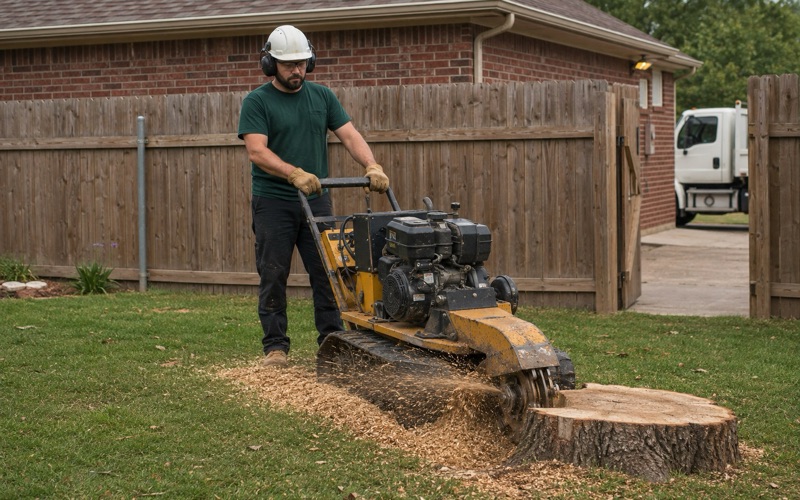
A stump grinder on this ground is limited by the machine, not by geology. The rated cut of the machine classes used here runs roughly 12 to 25 inches below grade, and against a solum measured in feet rather than inches, that rating is what ends the job. Grind depth in Harvest is a machine-class question and an access question, decided by which cutting wheel fits through the gate.
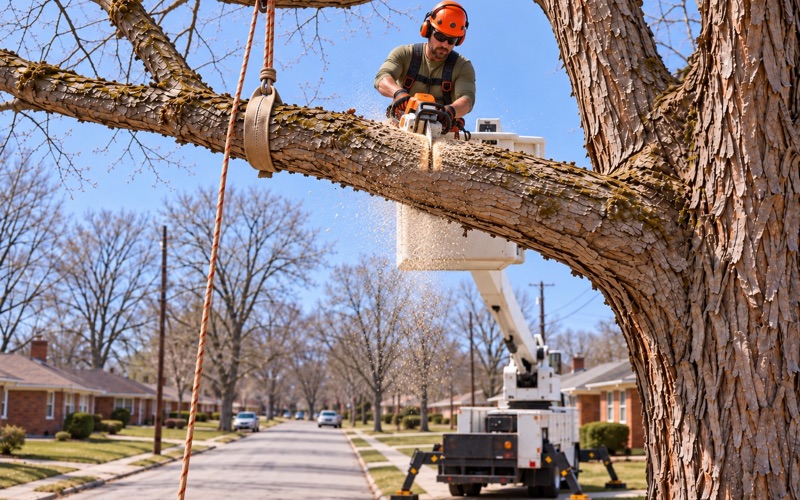
Access decides the machine, and on a subdivision lot the gate is usually the constraint. We quote crane and tracked-lift work for trees standing over a roof and narrow-access machines for fenced back yards, on the machine that will actually fit rather than the one in the brochure, and the same measurement tells us which grinder can reach the stump.
Depth is set by what the hole is for
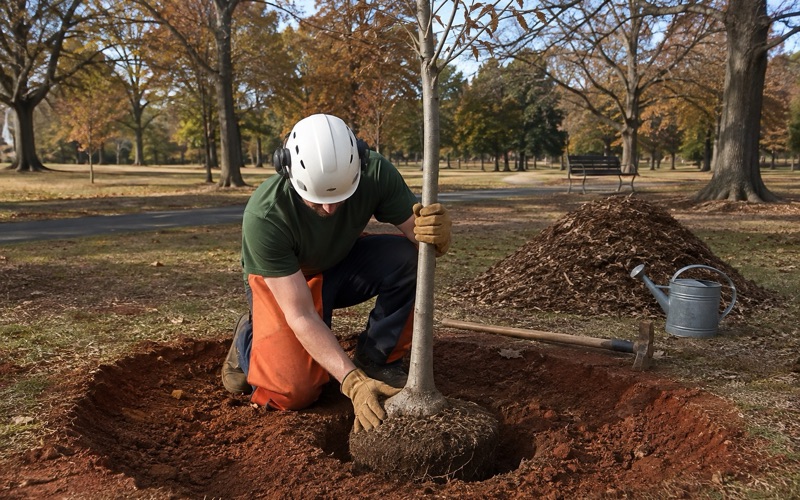
Grinding a stump to the depth a sod patch needs is a different job from grinding one deep enough to plant a replacement tree, and different again from clearing the line of a footing or a fence post. We set the depth against what is going into the hole afterward and we write that depth on the estimate.
Fill complicates the cut in a way undisturbed soil does not. Compacted subgrade takes the teeth differently than loose residuum, and nobody knows what a particular fill was made of until the wheel is in it, so we quote grinding on the depth and diameter we can commit to rather than on a promise about the material.
The grindings and the limbs are not going to the curb
Madison County Waste Control and Recycling does not collect debris generated by contractors: a resident who hires someone for yard work is told the contractor is responsible for removing it from the property. The county’s large-debris list names tree stumps first among the items it will not pick up, and caps green waste at limbs less than 8 ft in length.
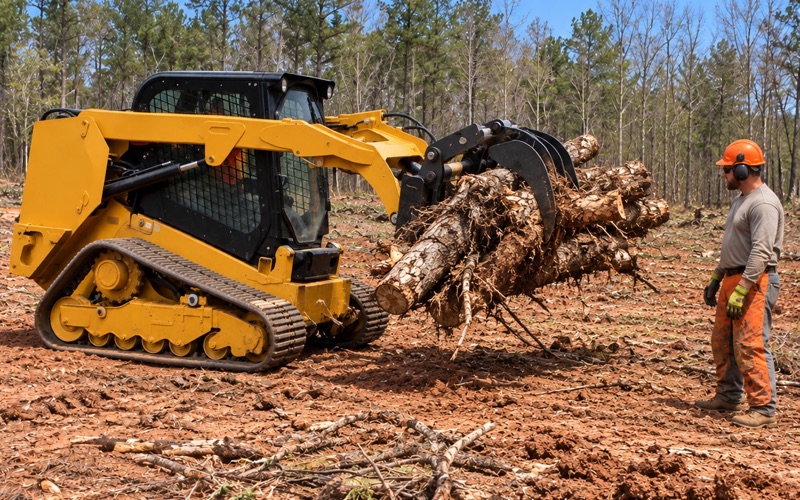
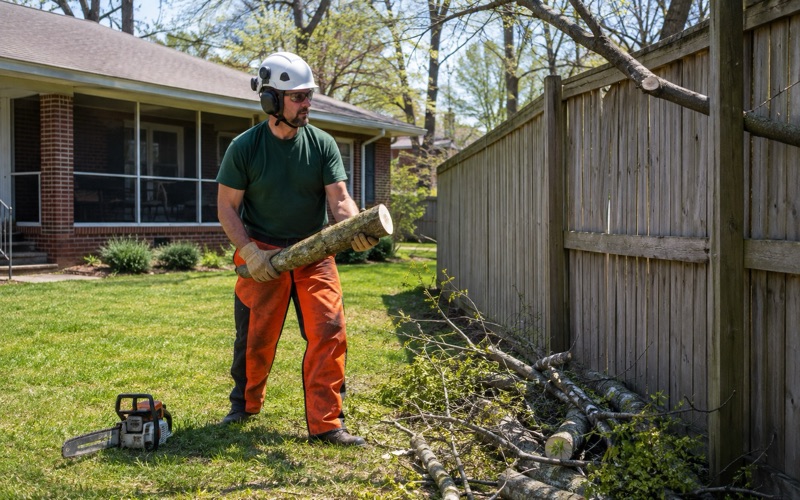
That closes the cheapest exit on a stump job here, so we state haul-away on the quote in words, included or not included. A low number that leaves a pile in the driveway and a higher number that leaves nothing behind should be comparable on paper before either one is accepted.
The firewood credit gets the same treatment. It is worth least where a county gate takes yard debris free, and most on a job where the wood has nowhere local to go, which is the situation on a Harvest lot with a contractor’s name on the truck.
A root plate grown in engineered soil fails in its own way
Roots follow air and water, and compacted subgrade offers little of either. They turn where they meet the dense layer and run outward through whatever loose material sits above it, so the plate that has to anchor the tree develops inside a shallow horizon the soil survey never described.
That matters most when the wind loads it. A plate that spread through a shallow layer of loose material over compaction is holding on with less depth than its diameter suggests, and a tree that looks well anchored in summer is being judged on the part of it nobody can see.
The flare tells you where grade used to be
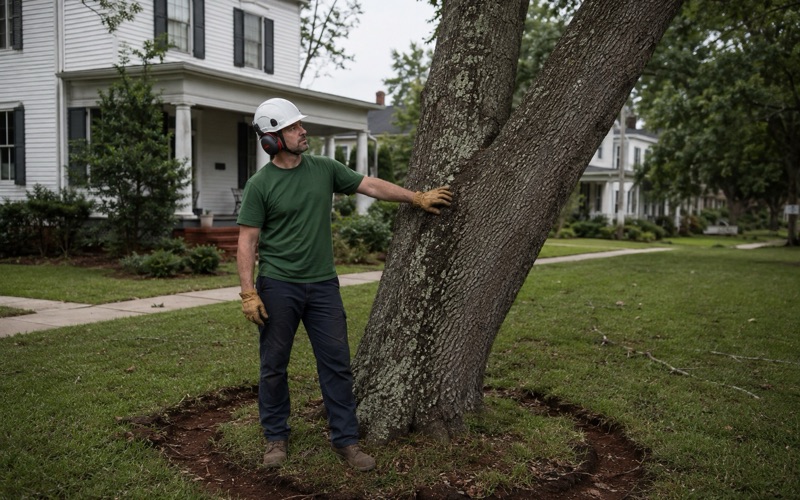
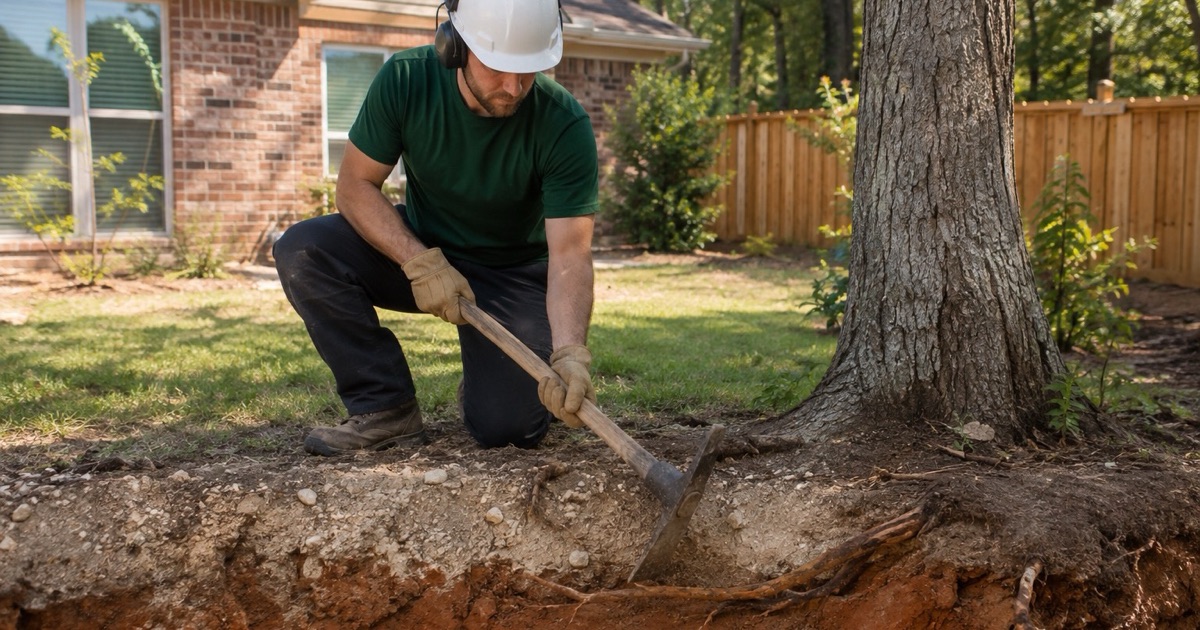
When fill is placed against a trunk, the root flare ends up buried and the tree’s first structural roots sit deeper than they appear. Root collar excavation, which means removing that material carefully to expose the flare, is how we find out whether we are looking at a girdling root, a decayed collar, or a sound tree that was simply buried after planting.
On a lot this age the flare is worth finding before anything else is decided. A trunk that goes into the ground like a post, with no visible taper, is telling you the current grade is not the grade the tree grew in.
Measure the damage against the trunk, not by eye
Where roots have already been cut, by a trencher, a utility crew or an earlier grading pass, the tree care standard sets the trigger by trunk size rather than by appearance: mitigation is recommended where roots are damaged within six times the trunk diameter measured at breast height. We measure diameter at breast height and mark that radius on the ground before forming an opinion about whether the tree stays.
That radius is usually larger than people expect, and it frequently reaches under a driveway or a patio poured with the house. Knowing where it falls is what separates a tree worth treating from one worth removing while the removal is still straightforward.
Soil decompaction and air-tool root work, which almost nobody here offers
Compaction is the one thing about a graded lot that can be worked on directly rather than merely lived with. The tool is an air-excavation device: compressed air fractures soil and lifts it away from roots without cutting them, which is what makes root work possible in ground that a shovel would ruin.
Radial trenching outward from the trunk, backfilled with material that holds its structure, and soil decompaction across the root zone are the established treatments. They are also close to unavailable in this market, where the offer is overwhelmingly removal and pruning, and the equipment is a low-volume line for any crew that buys it. The practical consequence is that trees which could have been recovered get quoted as takedowns instead.
Call 811 before anything goes into the ground
Alabama 811 receives the mandatory locate request before excavation, and that requirement reaches stump grinding and root excavation exactly as it reaches planting. We place the locate before a grinder or an air tool starts work, on a decompaction visit no less than on a removal.
Who signs off, when there is no city to ask
Harvest is an unincorporated community and census-designated place in northwestern Madison County, so there is no city tree ordinance and no municipal permit to pull for a removal. What governs is the county and the state instead. Madison County Public Works enforces the Madison County Subdivision Regulations in the unincorporated areas and manages the right of way that a front-yard tree may be standing in, and ADEM’s construction stormwater general permit ALR100000 reaches land disturbance of one acre or greater, along with smaller sites that form part of a common plan of development or sale.
The rule most likely to actually bind a particular Harvest lot, though, is the recorded declaration of covenants filed with the Office of the Judge of Probate of Madison County. Where a subdivision carries one, that document and its architectural control committee are the operative tree rule on the street. It is what we would read before anyone quotes a diameter threshold to you here.
- 20+ Years in the Tennessee Valley
- Free Written Estimates
- Same-Day Storm Response