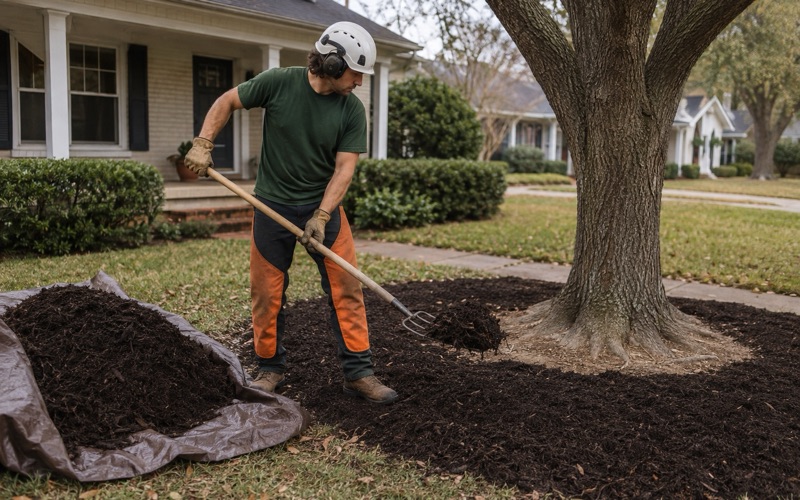
Decatur Tree Removal Pros has been doing tree service in Huntsville for more than twenty years, and the work here has a pattern that surprises people the first time they hear it: whole streets tend to need us at roughly the same time. That is not a sales line. It is what the city’s housing data and the trees standing in front of those houses say when you set them next to each other.
Our estimates are built to make that manageable rather than alarming. The takedown, the stump and the debris are priced as three separate lines, because those are the three numbers competing quotes disagree about. Haul-away is written on the quote in plain words, included or not included, so a cheap bid and an expensive one can actually be compared.
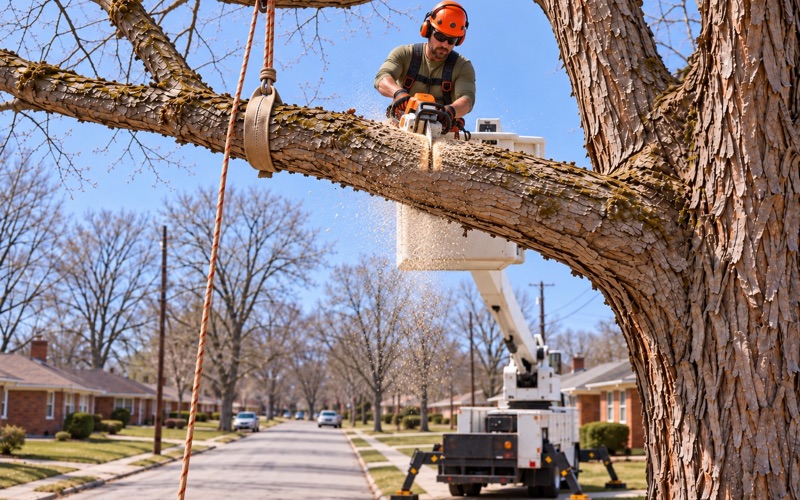
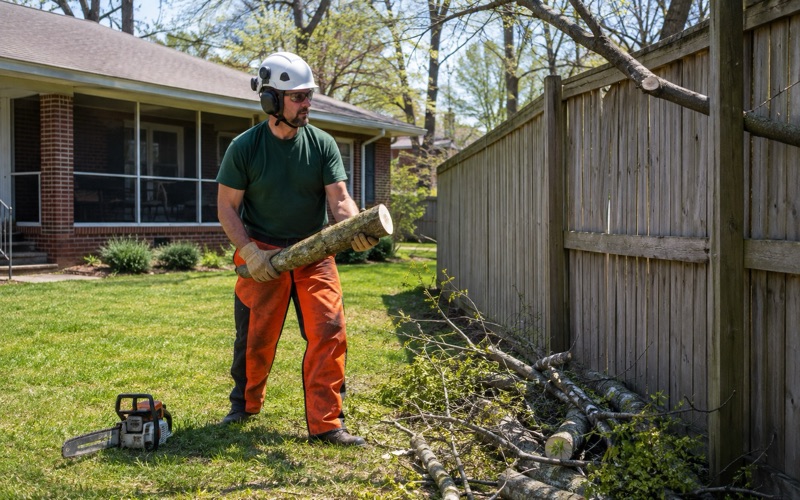
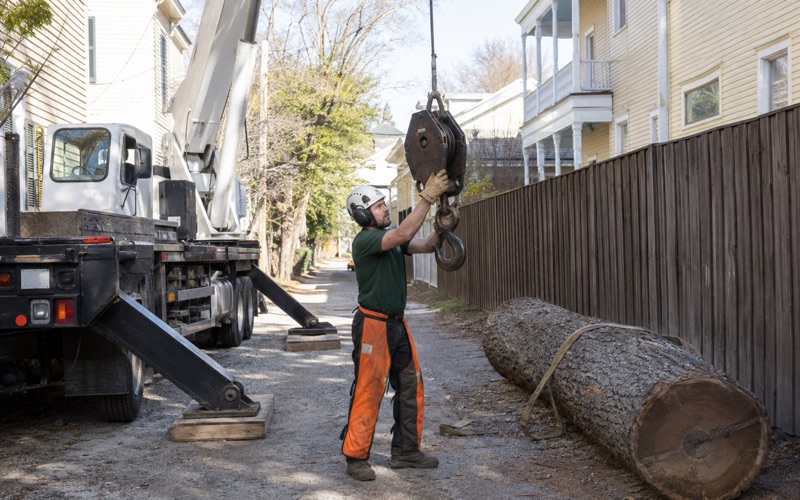
Access is measured before the tree is priced. Gate width, the drop zone, the carry distance back to the truck and where a chipper that will never fit through a side gate is going to sit change the labor on a job more than the height of the tree does. Where a trunk stands over a roof we quote the crane or the tracked spider lift that will actually reach it, and where a back yard is fenced we quote a narrow-access machine that fits the gate we measured.
The decade that built a fifth of the city, and the canopy that came with it
Huntsville has 104,388 housing units, and ACS 2024 five-year estimates under table B25034 put 43.6 percent of them up before 1980. The number inside that one is the interesting part: 18.8 percent of the city’s entire housing stock dates from the single decade of 1960 to 1969, the Apollo build-out. Just under one house in five went up in ten years.
Houses do not arrive by themselves. A subdivision platted and sold in that decade got its yard trees in the same few springs, at the same nursery size, planted into the same graded lots by builders working from the same plan. Six decades later those trees are not a scattered population of mixed ages that happens to share a neighborhood. They are a cohort, and a cohort has a schedule.
That matters more here than it would in a city of apartments. 63.1 percent of Huntsville’s housing is one-unit detached, and B25032 publishes 51,099 owner-occupied single-family detached homes directly, which is to say the yard tree is the normal case in this city rather than the exception. When a cohort reaches the end of its useful life, it does so across a street instead of in one yard.
Which species went in sets how fast that clock runs. Section 27-55(c) of the city code lets Huntsville Utilities widen its line clearances to fifteen and twenty feet for a named list that includes hackberry, boxelder, silver maple, cottonwood and loblolly pine. That is the city’s own written statement of which trees grow back into a wire fastest, and it is the same short list of brittle, fast, short-lived species that generates the most removal calls around here. A street planted heavily with them reaches its cohort failure well ahead of a street of oaks.
Ash puts a second clock on any street that has it. The Alabama Forestry Commission confirmed emerald ash borer in Madison County on June 6, 2025, its first confirmed observation in this county, and describes the damage as usually beginning at the top of the crowns of ash trees and proceeding downward. Where ash went into a 1960s planting, that part of the cohort does not wait for old age to arrive.
Looking for tree-removal closer to Redstone Arsenal? See Redstone Arsenal Tree-Removal.
What a sixty-year-old yard tree is doing that a forty-year-old one is not
It reports from the ground first
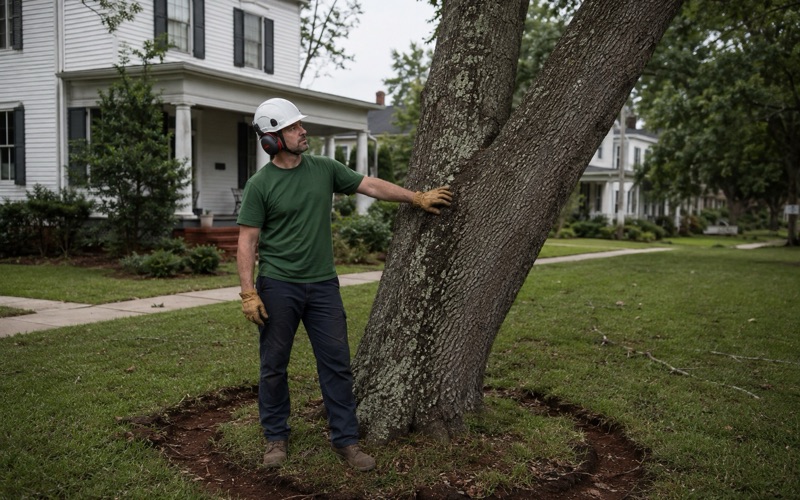
A tree twenty years younger usually tells you about itself from the crown. A sixty-year-old one tells you from the base. We start at the root collar, because six decades of added mulch, regrading, driveway widening and settled fill routinely bury a flare that ought to be visible, and a buried flare is exactly where girdling roots and collar decay develop out of sight.
Two findings change a recommendation on the spot. A conk or bracket fungus at the flare is fruiting from decay already inside the trunk, and mounding or cracking of the soil on one side of the root plate is the plate itself beginning to lift. Neither is subtle once you know the shape of it, and both hide comfortably under turf, ivy and sixty years of leaf litter.
The union is where identical trees fail identically
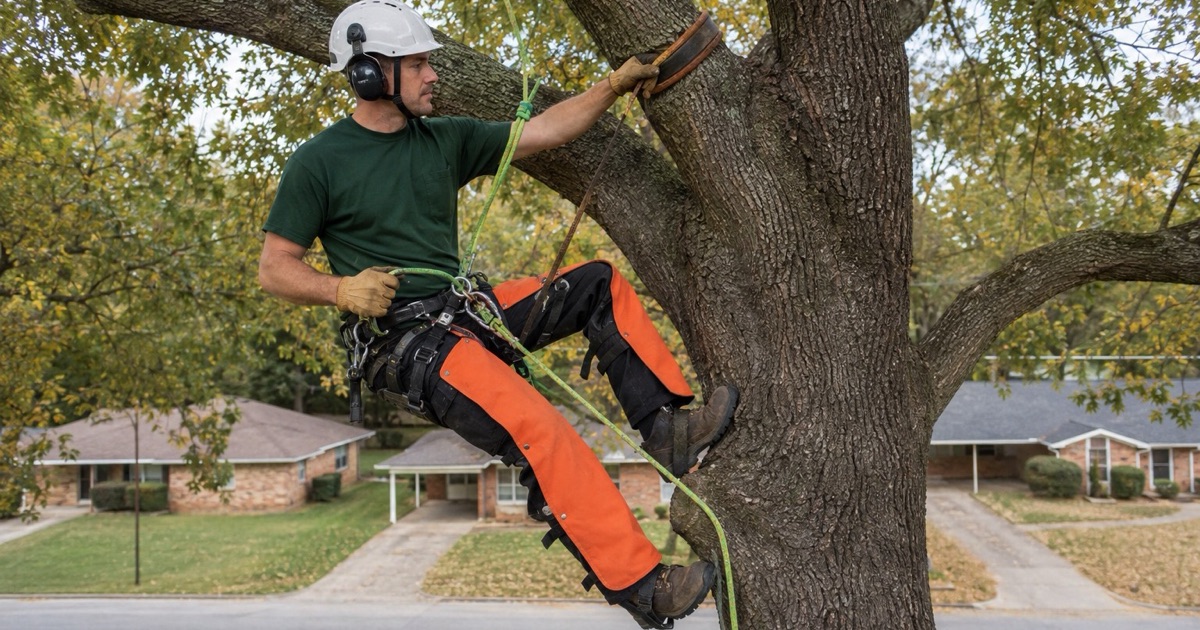
Trees planted together in the same yard also fail the same way. A harmless fork on a fifteen-foot nursery tree becomes two competing sixty-foot leaders with included bark pressed between them, which means bark rather than wood is holding the union closed. On a cohort street we find that same union on house after house, at much the same height, in the same species.
Where the rest of the tree is sound, the union is the part that can be treated instead of removed. Static and dynamic cabling systems and threaded steel bracing rods address it directly, and reducing end weight above it is written as a pruning specification under ANSI A300 rather than done by topping. Topping trades one failure for a flush of weakly attached epicormic sprouts and a decay entry at every cut.
How much sound wood is left
Where the real question is shell thickness, we sound the trunk with a mallet and, when the answer carries weight, use resistance drilling to estimate the decay column and the wall of sound wood around it. That measurement is the difference between removing a tree because it looks rough and keeping one that has decades left in it. It also makes a removal recommendation something a homeowner can check rather than take on faith.
Reading a whole street instead of a single tree
Nearly every call starts with one tree. On a street built in the sixties the honest answer usually involves the other trees in the same yard, because they are the same age, often the same species, and standing in the same soil under the same weather.
So when we come out for one tree we walk the property and note what is visible from the sidewalk on the frontage next door. That is not an attempt to sell six removals; most of what we note is not urgent. Some of it is a two-year item and some is a five-year one, and separating those is most of what the walk is worth.
Priority is set by what sits under the tree, not by how the tree looks from the driveway. The same declining trunk over an open back corner and over a bedroom are not the same job and do not belong in the same year, and a compromised union over a driveway where cars park all day outranks a worse one over open lawn.
The wire between the pole and the house comes up on almost every one of these walks, and it gets three different answers around this ring. In Huntsville the answer is written down: Huntsville Utilities states that the responsibility of clearing trees from customer service wires, pole to house, rests entirely with the customer. We plan around that rather than sending a crew that assumes somebody else is coming to deal with the line.
The utility’s own program covers a narrower case than most people expect. For street-side trees it removes, Huntsville Utilities grinds all resulting stumps and offers a one-for-one replacement voucher for up to three trees at participating local nurseries, and both apply only to street-side trees it removes, not to a back-yard tree and not to a tree taken down at a specific customer request. Knowing which side of that line a tree falls on before the estimate is written keeps a homeowner from paying for work that was not theirs, or waiting on help that was never on offer.
Spreading the work across seasons, and what goes back in
A cohort comes down on your schedule or on the weather’s. Huntsville asks no municipal permit for a tree on your own property: section 27-52(a) establishes that trees on private property belong to the landowner, while recognizing their public usefulness and their value in energy conservation, in moderating extremes of temperature and humidity, in reducing noise, glare and air pollution, in reducing soil erosion, and in improving the city’s aesthetic character. The tree commission’s role there is technical guidance to landowners, not approval. Three trees this winter and three the winter after is a perfectly legitimate plan.
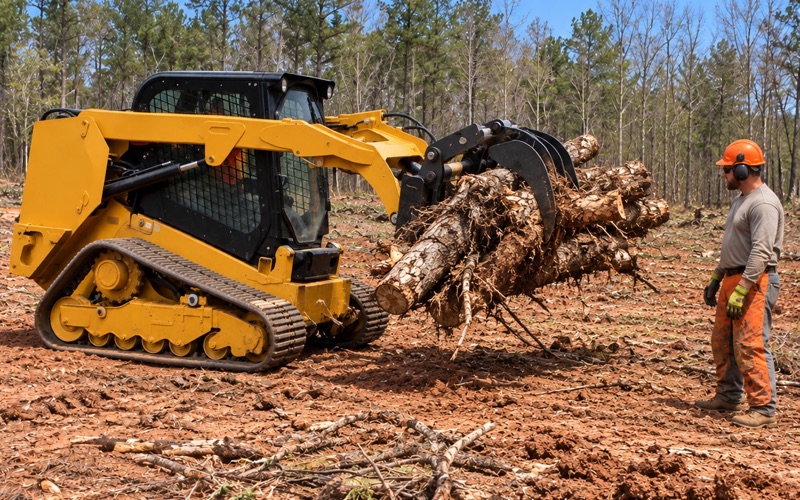
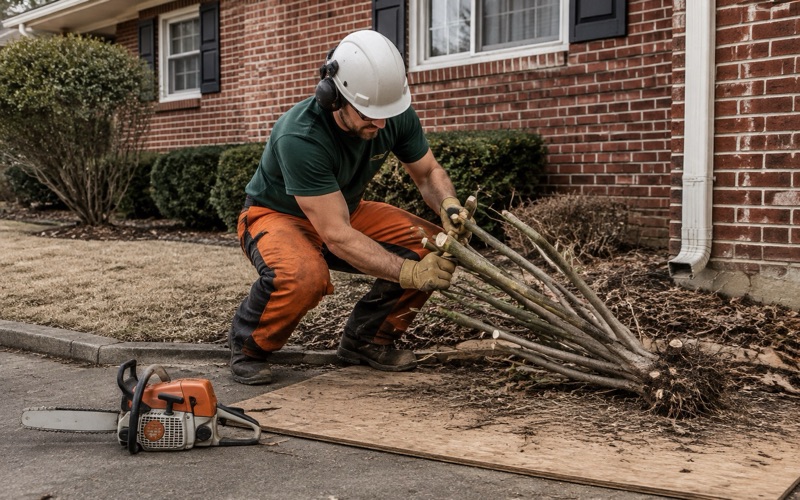
Sequencing has consequences past the calendar. Everything in one week makes one enormous pile, and the city collects tree limbs up to ten cubic yards at no charge, with a pile over that chargeable at 55 dollars for collection and each additional five cubic yards a further 55 dollars, billed onto the monthly Huntsville Utilities bill. Limbs cannot exceed five feet in length, and the city states plainly that it will not pick up debris resulting from a contractor’s work. That is why our haul-away line says in words whether we are taking the wood or leaving it stacked.
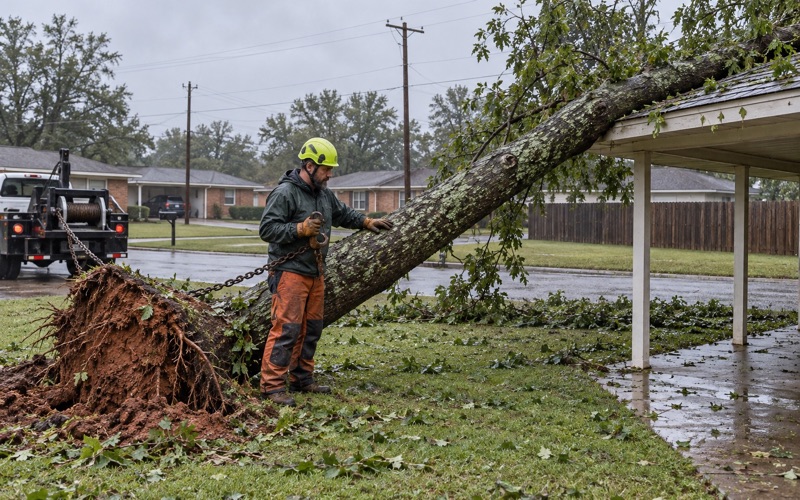
Storm work is what happens instead of sequencing, and it is worse on every axis. We answer storm and hazard calls the same day, but a saw does not go near an energized conductor in high wind, ice or an active thunderstorm; ANSI Z133 sets those limits on arboricultural operations and they are not negotiable at two in the morning. A tree taken down on a clear Tuesday in February costs less and breaks less than the same tree lifted off a roof in April.
The stump, and the cohort after this one
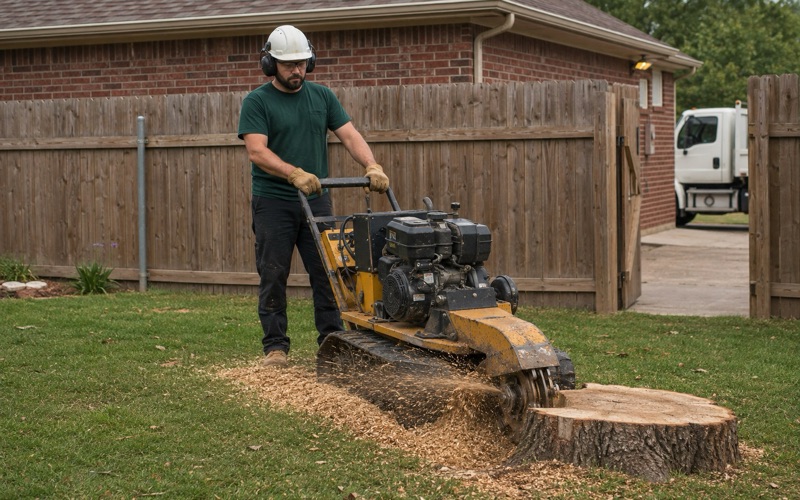
The stump is its own decision and its own line on the quote. Valley-floor soils here are deep residual soils over limestone rather than a thin skin over rock. The Decatur series, type-located in Limestone County, carries a solum more than 72 inches thick with limestone bedrock deeper than six feet, so on most lots in town the limit on a grind is the cutting wheel’s rated depth, typically 12 to 25 inches below grade, rather than bedrock. We say which depth we are quoting, because a grind for turf and a grind deep enough to plant into are different jobs.
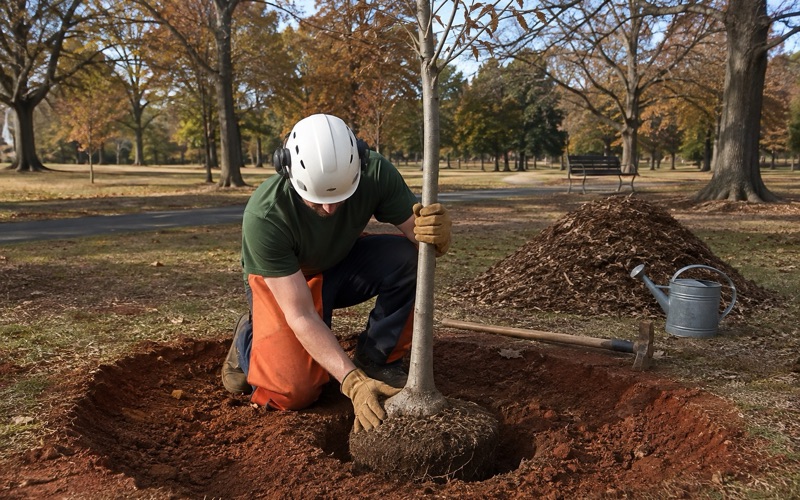
Replanting is where the cycle gets broken. Five identical trees back into five identical holes rebuilds the same problem for whoever owns the house sixty years from now. Staggering new plantings across several seasons, and drawing species from the oak-hickory community that belongs on this valley floor instead of from the fast list the utility has to keep cutting out of its wires, spreads the next generation’s maturity over decades rather than stacking it into one bad decade all over again.
- 20+ Years in the Tennessee Valley
- Free Written Estimates
- Same-Day Storm Response