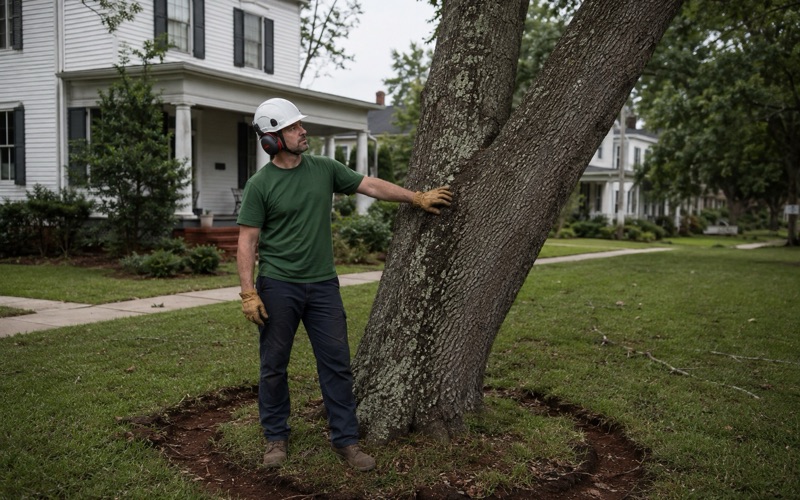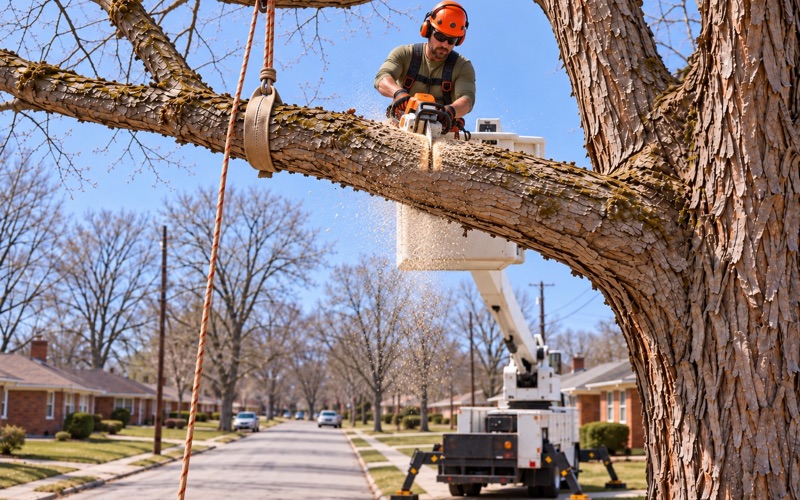
Decatur Tree Removal Pros handles tree removal in Madison for homeowners whose yards have reached the point where a tree planted at the same time as the house has outgrown the spot it was given. Twenty years and more of tree work across the Tennessee Valley, over three genuinely different kinds of ground, is what tells us which of those trees is a real hazard and which one is simply large.
Most of what we quote here is not storm damage. It is a first removal: a pear that has lost a third of its crown to a split, a row of screening evergreens that closed up and then started dying from the inside, a maple whose roots have found the driveway. The tree is thirty years old, not a hundred, and that changes both the work and the price.
Every estimate we write separates the takedown, the stump and the debris into three priced lines, because those are the three numbers competing quotes disagree about. A single figure hides which one of them is missing.
The first removal cycle in a neighborhood built in the eighties and nineties
Madison’s housing stock is young, and the ACS 2024 five-year estimates put a number on it. Of the city’s 23,278 housing units, only 11.3 percent were built before 1980, while 62.5 percent went up between 1980 and 2009. Nearly two out of every three houses here are a generation old, not a century.
That decides what is standing in the yard. A lot built in 1994 was landscaped in 1994, so the tree we are asked to take down is almost always one that arrived with the house rather than one the house was built around. It was picked from what nurseries were pushing at the time: fast, cheap, uniform, and sold on how it looked in its first ten years rather than its third decade.
What a thirty-year-old ornamental is doing now
Thirty years is about when those choices come due. A tree bred to look tidy at fifteen feet is now thirty-five feet with a crown wider than the space between two houses, and the first branch failure is usually the phone call. None of that is neglect. The tree is doing what the species does once nobody is trimming it back into a nursery shape.
We price these jobs on access before anything else. Gate width, the drop zone, the carry distance back to the truck, and where a chipper that will never fit through a six-foot gate is actually going to sit all get measured before a number goes on paper.
Why failures here are unions rather than root plates
The soils on these limestone uplands are deep and well drained. The Decatur series, whose type location sits in neighboring Limestone County, carries a solum more than 72 inches thick with limestone bedrock deeper than six feet, and the Dewey series formed on the same uplands runs more than 60 inches to rock.
Deep soil lets a tree build a genuine root plate, so the failure we meet on a settled Madison lot is far more often a limb or a union coming apart than a whole tree tipping over. That is worth knowing before a removal is ordered: the hazard is usually a defect in one part of the tree, and the question is how the wood is joined rather than whether the ground will hold.
Looking for tree service closer to Huntsville? See Tree Service Services in Huntsville.
Bradford and Callery pear: why they split, and what taking one out involves
Callery pear and its Bradford selection went into this housing stock in enormous numbers, and they are the most common single removal we do in Madison. They are easy to pick out even off season: the early white flower that opens before anything else leafs out, a dense upright form that looks pruned when it is not, and thorny sprouts off the base and off any cut surface.
The union is the defect
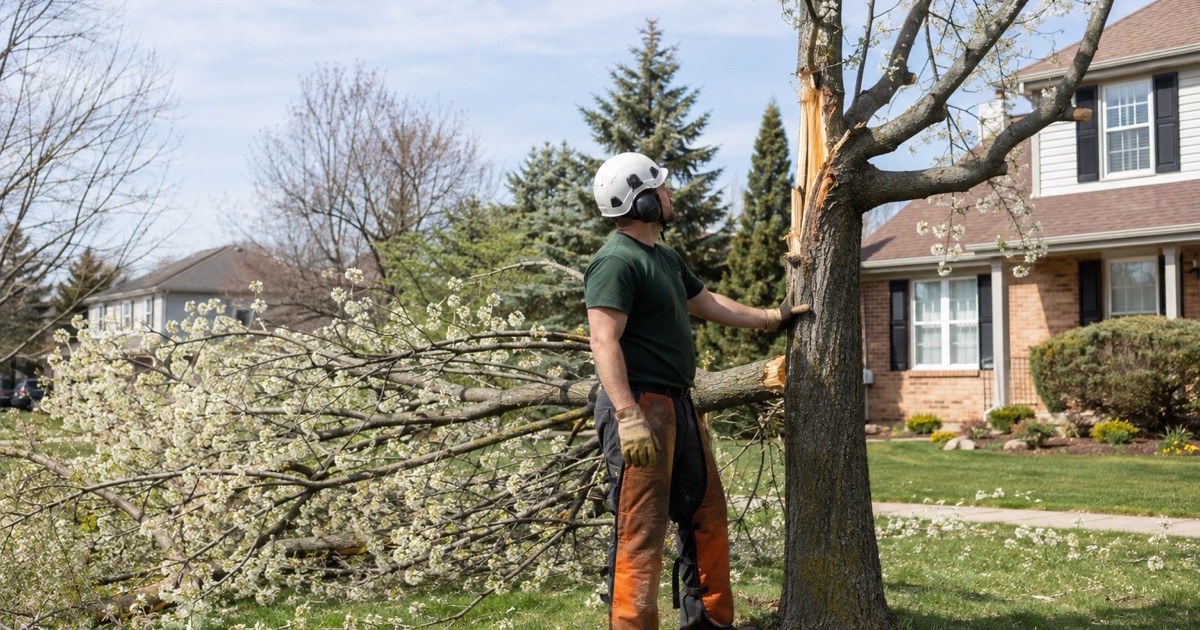
The structural problem is built into the shape. Branches leave the trunk at a narrow angle and in tight vertical succession, producing co-dominant stems with included bark, which is bark trapped inside the joint instead of wood grown across it. A union like that is held mostly by wood loaded in tension perpendicular to the grain, the weakest way wood can be loaded, and that is why a pear that looked fine in March is in three pieces by June.
Once one leader has gone, the rest is rarely worth keeping. The remaining stems carry the same defect at the same height, and the crown is now unbalanced over whatever the missing leader used to shade. We would rather dismantle the tree in sections and be done than reduce it twice and remove it anyway.
Grinding the stump so it stays gone
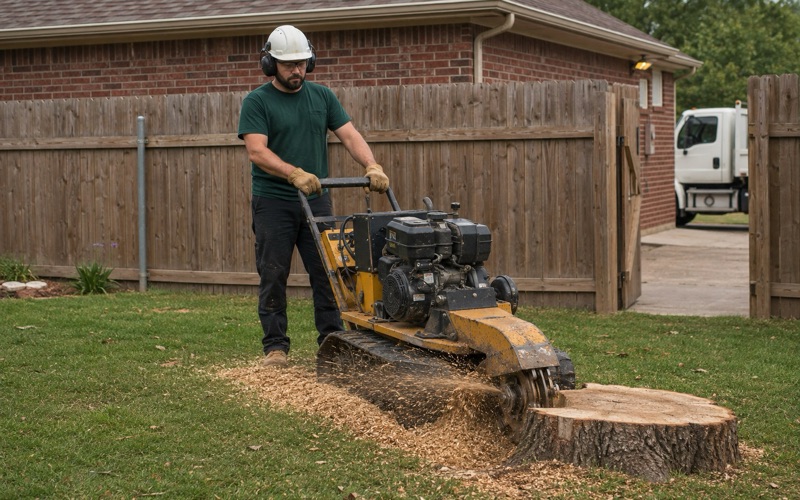
A pear removal is not finished at the stump line. The Alabama Cooperative Extension System’s control guidance for Callery and Bradford pear is that the stump has to be ground out with the lateral roots taken with it, or the tree resprouts, and it resprouts as a thicket of thorny shoots that is harder to deal with than the original trunk was.
This is where the deep soil helps. Because bedrock sits well past six feet on these uplands, the limit on how far we grind is the machine’s own rated cut, commonly 12 to 25 inches below grade depending on the class of grinder, rather than rock stopping the wheel. On a thin soil over limestone we could not promise a depth. Here we can commit to one, and to chasing the laterals out beyond the stump instead of only lowering its center.
Because the stump is its own priced line, you can see what that work costs rather than find it folded into a takedown number or quietly left out of a cheaper quote.
Leyland cypress screens, the spacing they went in at and the size they reach
The other signature planting of this era is the Leyland cypress privacy screen, set along a rear property line to close the gap between two new houses. Alabama’s published figures give the tree a mature height of 70 feet or more and a recommended minimum spacing of 15 to 20 feet on centers. Screens around here went in at six to eight feet apart, because the point at planting was a solid green wall within a few years.
What six-foot spacing produces at thirty years
It works, and then it stops working. The row closes, the interiors shade out and die back to bare stems, and the screen becomes a line of tall trunks carrying green only at the top and on the outer face, which is the opposite of what it was planted to do. Crowded, stressed trees are also the ones that show Seiridium canker, and once branches start browning off in patches the row rarely comes back as a screen.
At seventy feet on a six-foot spacing there is no pruning answer. The trees cannot be cut back into a hedge without stripping the live foliage they have left, and thinning the row after the fact does not put growth back on the inside of the survivors.
Working a screen out of a fenced back yard
A cypress row is a hard place to work, which is why we quote it on access first. The screen sits on a property line behind a fence, often with a neighbor’s fence a few feet the other way, and there is no lane for a bucket truck.
We take these down in sections with rigging and bring in narrow-access machines that actually fit through a residential gate, quoted on the equipment that will fit rather than the one in the brochure. Where the chipper has to stay in the driveway, carry distance is the real cost of the job, and it belongs on the estimate as debris instead of buried in the takedown line.
Replanting a screen that will not do this again
Most people still want the privacy. What changes the second time is spacing and species mix: fewer plants, set far enough apart that each one can hold foliage to the ground, and more than one species in the row so a single canker does not take the whole line at once. A row at proper spacing looks thin for a few years and then works for thirty. A row planted for instant coverage looks finished in four and is a removal job in twenty-five.
Ornamentals that have grown into the roof, the driveway and the foundation
The rest of what comes down here is the supporting cast of the same landscape plan: a silver maple twelve feet off the slab, a pair of ornamentals flanking a walk the walk now runs through, a shade tree squeezed between a driveway and a property line. Nothing was wrong at planting. The spacing simply assumed a smaller tree than the one that grew.
The damage patterns worth acting on
Roots reach the driveway long before they reach a foundation, and a lifted slab section is usually the first visible sign. Girdling roots circling the root collar are the other common find on a nursery-grown ornamental of this age, invisible until the collar is excavated, and they account for trees that decline for no reason the crown gives away.
Limbs over a roof are a separate item. On a house of this vintage the framing is fine; the problem is a crown that has grown out across a roof plane and now sheds enough onto it to keep shingles wet and gutters loaded.
Who actually approves a removal here
There is no city permit for taking down a tree on a finished single-family lot in Madison. The Official Zoning Ordinance of the City of Madison, effective July 1, 2026, contains no tree preservation article and no removal permit. Its tree rules are development-side, and Section 7-5-3 states plainly that its landscaping standards apply in all zoning districts and to all uses other than single family detached dwellings.
What often does decide it is the subdivision covenant. A Madison-area declaration recorded at Madison County Probate Book 0889, Page 0751 in January 1997 provides that no trees may be removed without the board’s consent, except for diseased or dead trees, trees less than six inches in diameter, trees that must come out for safety reasons, and trees where an approved building will stand. The identical clause appears in a second local declaration, so it is replicated drafting rather than one subdivision’s quirk. Read your own covenant before scheduling a healthy tree; the city’s ordinance disclaims enforcing covenants it is not a party to.
Where the brush goes
The curbside rule here is stricter than most homeowners expect, and it is written down. Republic Services, under contract to the city, collects five cubic yards of yard debris per household per week, and limbs must be cut to lengths not exceeding eight feet with protruding branches trimmed and stacked in a neat pile.
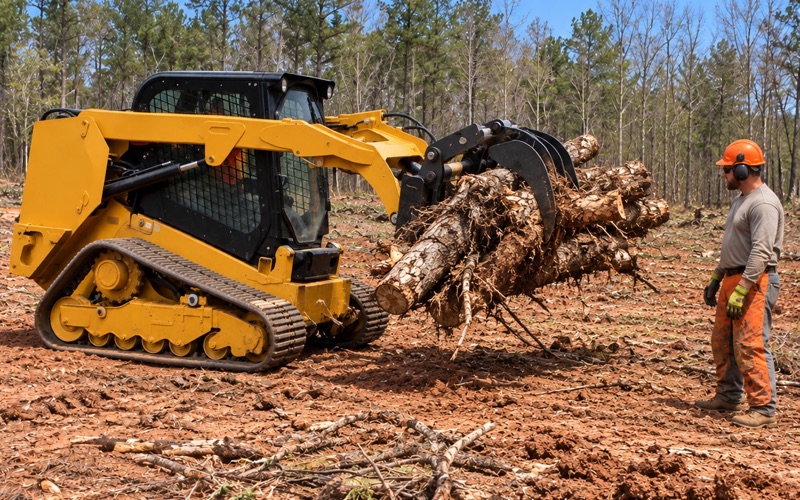
The same policy excludes contractor debris outright: waste generated by commercial workers or professional lawn services cannot be put out for collection. Haul-away is therefore not an upsell but the only lawful route off the property, which is why our quote says in words whether it is included. The firewood credit gets the same treatment, quoted for what it is actually worth on the job rather than offered as a favor.
- 20+ Years in the Tennessee Valley
- Free Written Estimates
- Same-Day Storm Response