Decatur Tree Removal Pros has been doing tree work in the Tennessee Valley for more than twenty years, and tree removal in Redstone Arsenal is unlike nearly anywhere else on our map for one structural reason: there is almost no homeowner here to call. The resident who watches a limb hanging over the driveway is a tenant. The party who can decide the tree comes down is a property manager working under a government contract.
That gap changes everything downstream of it. A job is not scoped by walking one back yard with one owner and agreeing on one tree; it is scoped across a set of addresses, priced as a program, and scheduled around families who did not order the work and will not be paying for it.
So we quote this ground as a portfolio. A program covering several neighborhoods at once needs a survey before it needs a saw, a defensible order of what comes down first, and a written record when the crew pulls off the street. Those are the three things this page is about.
Who actually owns the houses on this installation
Redstone Arsenal is a United States Army installation and a census-designated place in Madison County, adjacent to Huntsville. It is federal land rather than a municipality, so there is no city council, no municipal tree ordinance and no city forester standing over a tree here, and no city permit reaches inside the boundary. Vegetation decisions run through the garrison, and on the residential side they run through the housing operator.
The housing numbers make the point better than any description of them. ACS 2024 five-year estimates record 351 total housing units on the Redstone Arsenal census-designated place, of which 9 are owner-occupied against 332 renter-occupied, or 2.6 percent ownership across the entire place. The 2020 census counted 837 residents.
Redstone Family Housing is managed by Hunt Military Communities and comprises 352 traditional and renovated homes across seven communities, with more than 30 floor plans running from two-bedroom townhomes with two and a half baths to five-bedroom homes with three baths. One organization therefore holds the residential tree inventory for more than 350 homes on this post. Nine households on the whole installation could hire a tree crew the way a Decatur homeowner does.
What a single decision maker changes about an estimate
For a private client we split every estimate into three priced lines: the takedown, the stump, and the debris. Those are the three numbers competing quotes disagree about, and separating them is what makes a cheap bid and an expensive bid comparable at all.
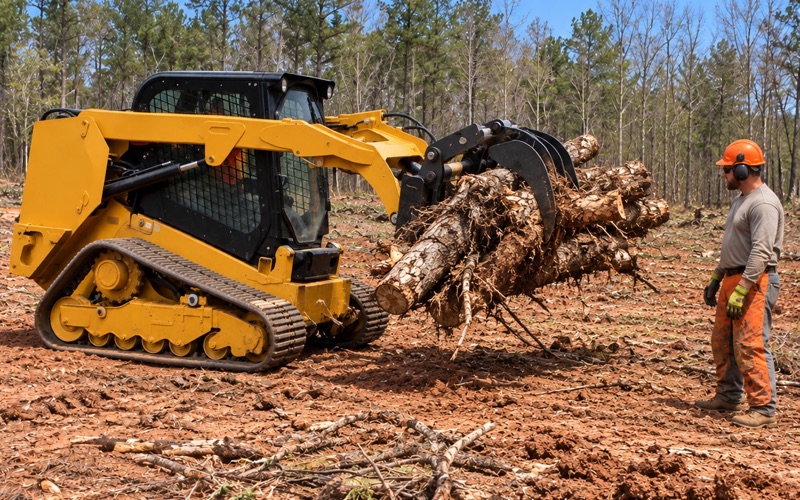
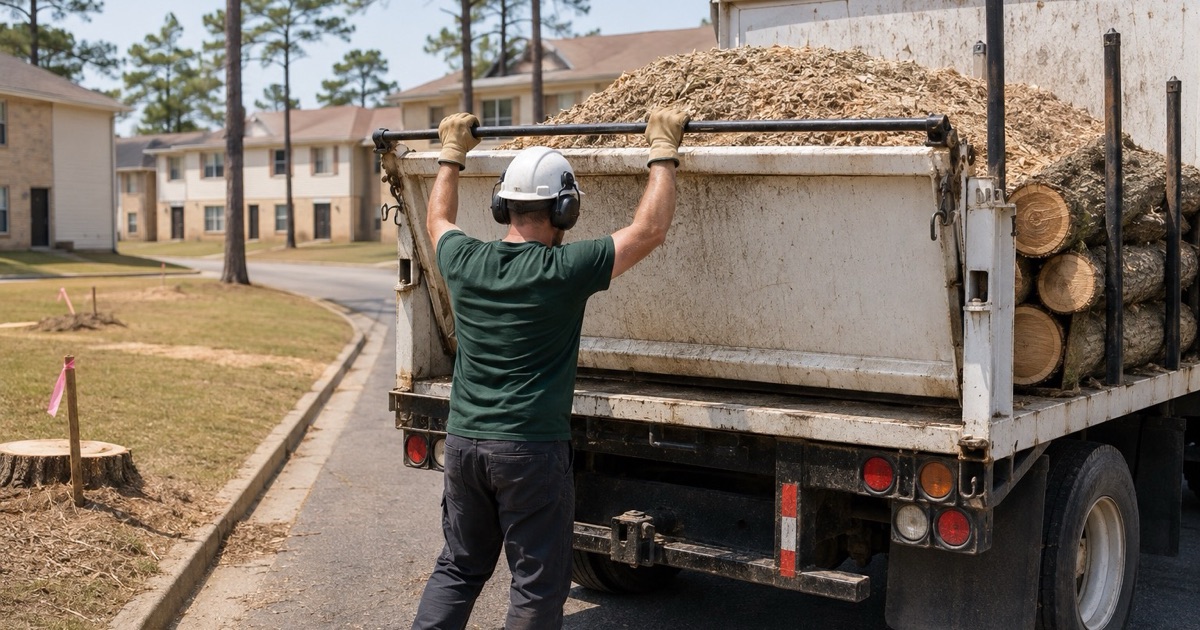
A housing operator reading bids across dozens of addresses needs that split more than a homeowner does, because the same three lines have to hold their shape from one street to the next. Haul-away is written on our quote in plain words, included or not included, rather than left to be argued about after the chips are on the ground.
Looking for tree-removal closer to Harvest? See Tree-Removal in Harvest.
A removal program across several neighborhoods, not a single call
Redstone Family Housing has a published tree removal project running across the Challenger Heights, Columbia Centre and Freedom Landing neighborhoods. That is the shape of work we plan for here: a defined footprint spanning multiple neighborhoods, sequenced in phases, rather than one address with one tree and one afternoon.
We scope that footprint before pricing it. The unit of measure is the street and the phase, not the individual stem, which means the quote has to answer how many crew days each neighborhood absorbs, what order the phases run in, and what happens to the trees that get deferred out of phase one.
Other neighborhood names reported for the installation include Saturn Pointe, New Endeavor, Endeavor Village, Voyager Village and Pathfinder Pointe. That roster comes from secondary reporting rather than the garrison’s own housing page, and the count of named neighborhoods does not reconcile exactly with the count of communities, so we treat any list of names as indicative and confirm the actual boundaries with the operator before a survey pass.
Access is measured before a tree is priced
On every job we measure access first: gate width, the drop zone, carry distance to the truck, and where a chipper that will never fit through any gate is actually going to sit. On a housing street those answers are set by parked cars, shared driveways and the fact that the yard behind the fence is somebody’s home rather than a work site.
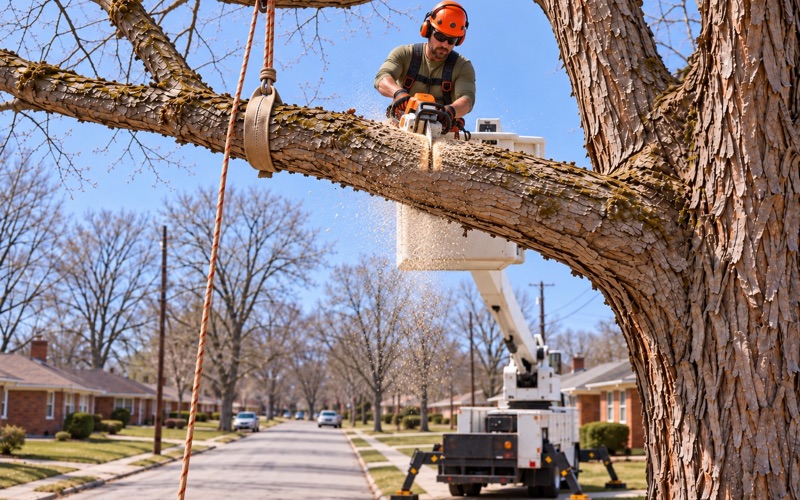
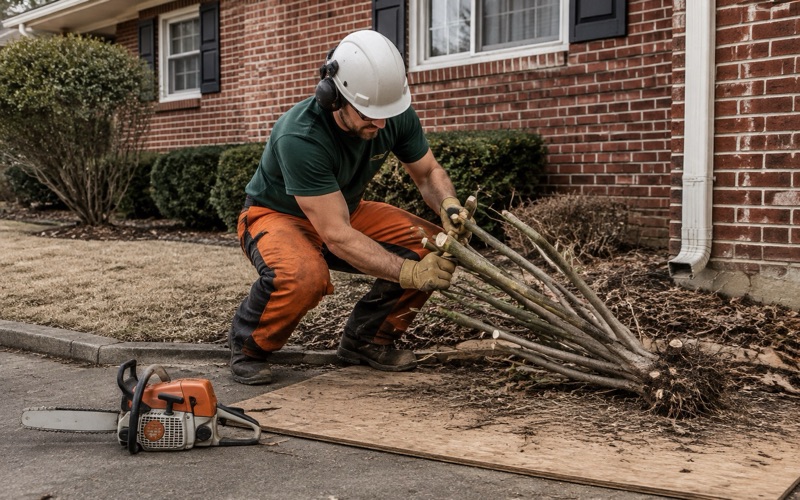
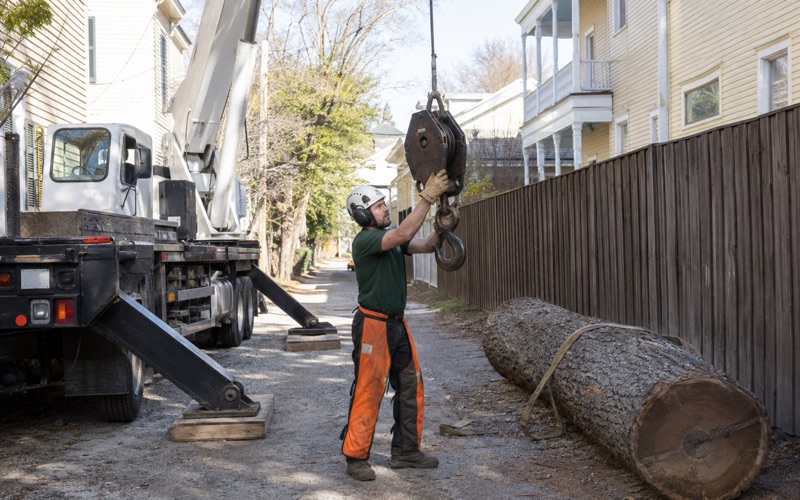
We quote on the machine that will actually fit rather than the one in the brochure. A tracked spider lift gets into a fenced back yard that a bucket truck cannot reach; a crane or tracked lift is the honest answer for a tree standing over a roof, and it belongs on the estimate at the start rather than as a change order once the crew is on site.
Surveying the portfolio and ranking what comes down first
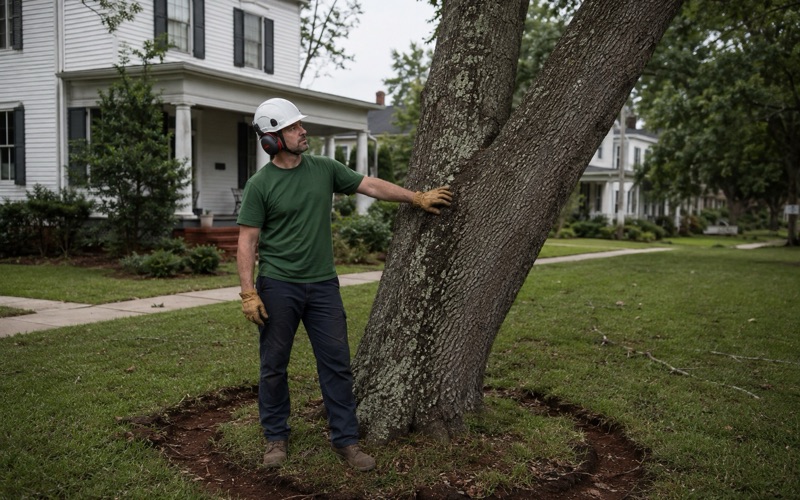
A program begins with a survey pass rather than a saw. We walk the streets in scope and record each tree the same way at every address: species, diameter at breast height, the condition of the root flare and root plate, co-dominant stems and included bark, girdling roots, epicormic sprouts, and anything a sounding mallet or resistance drilling tells us about a decay column and the shell thickness left around it.
Ranking follows from what the survey records. The logic behind a formal tree risk assessment is three questions in order: how likely the part is to fail, what it would hit if it did, and how bad that would be. On a housing street the answer to the second question is almost never empty, because there is a roof, a parked car or a play area under most of the canopy.
That is why a portfolio ranking on this installation does not look like a ranking of the same trees on open ground. A defect that would justify monitoring on a wood line moves up the list when the target under it is occupied, and a structurally sound tree in the wrong place stays low on the list even when it looks dramatic.
Ash reorders its own place in the queue
The Alabama Forestry Commission confirmed emerald ash borer in Jackson and Madison counties on June 6, 2025, the first confirmed observation in those counties. For a program covering hundreds of homes, that finding turns every ash in the survey into a scheduling question rather than a condition question.
It also changes what happens to the wood. The agency advises that infested ash trees which are cut down ‘should preferably be burned or destroyed on-site to slow down the dispersal of the insect,’ which makes disposal an operational instruction rather than a preference, and it is why hardwood firewood movement is worth settling in writing before the first ash comes down.
Stumps and the ground underneath them
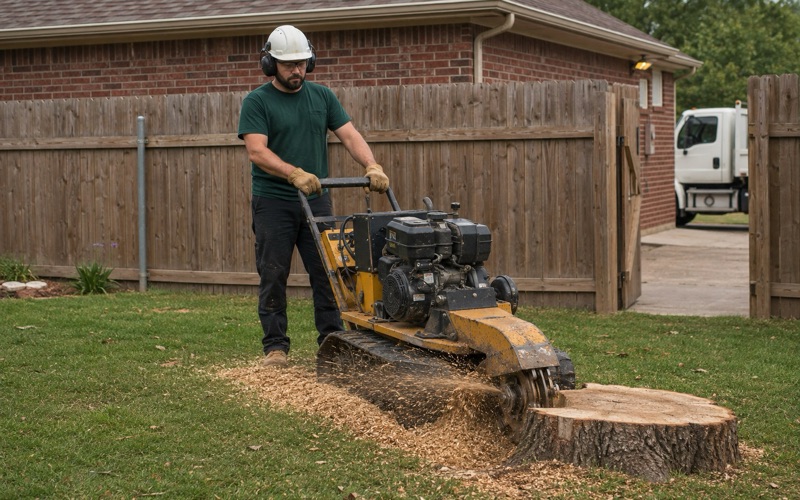
Soils here are well-drained, loamy, and derived from limestone erosion or alluvial deposits. Limestone ground carries chert, chert eats carbide teeth, and a grinder wearing out mid-program is a schedule problem rather than only a cost problem.
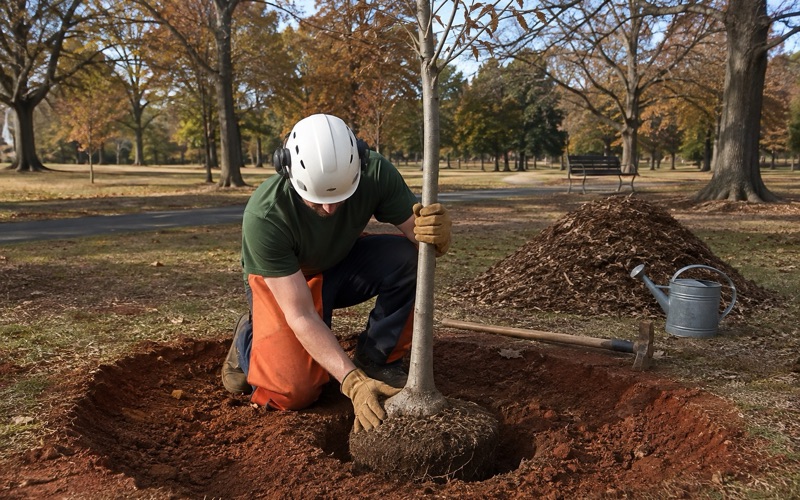
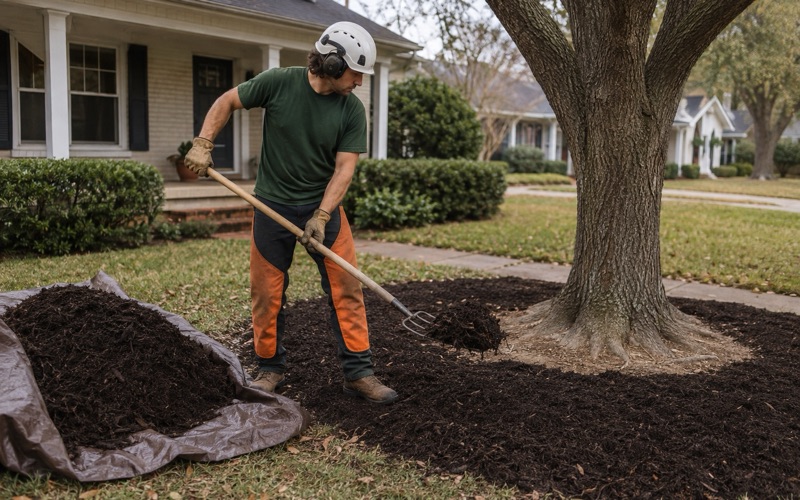
We agree grinding depth below grade once for the whole program rather than negotiating it stump by stump, because a lawn that will be mowed by a grounds contractor and replanted to turf has a different answer than a bed that is about to hold a new tree. The debris line on the quote says where the grindings go and who spreads them.
Scheduling around residents, and the record we leave behind
The household living under the tree did not order the work, and that is the practical constraint on the calendar. Notice on the door, a driveway cleared before the truck arrives, a drop zone that does not cross a play area, and a start time that works around school buses are all part of the scope on base housing, not courtesies added afterward.
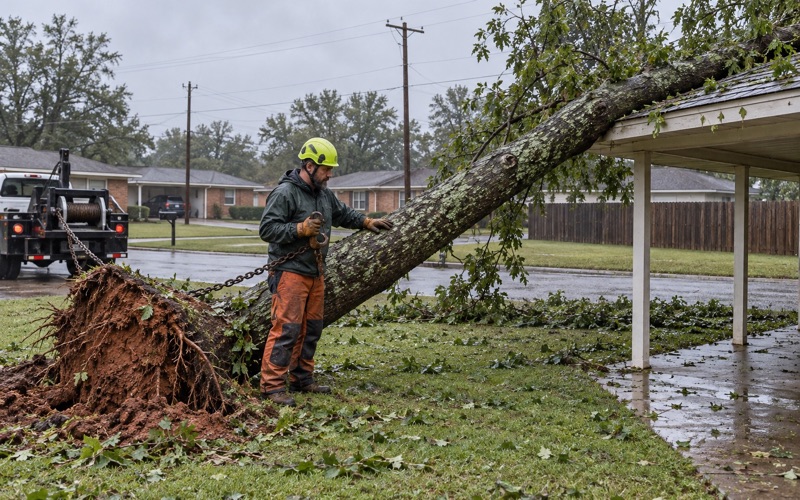
Storm and hazard calls are answered the same day, with the plain limits an industry safety standard puts on the work. ANSI Z133 governs how close a crew works to energized conductors and puts hard stops on aerial work in high wind, ice and thunderstorms, so a call at the height of a storm gets an honest answer about what can happen tonight and what cannot.
The wire between the pole and the house is one question we always answer straight. Around Decatur it has three different answers depending on which utility owns the ring, and the service drop between the pole and the weatherhead is where the disagreement usually sits. On this installation the resident is not the party who resolves it, so we take that question to the housing operator before we plan the rigging rather than after.
What the operator gets when the crew leaves
Written condition documentation is a deliverable in its own right, separate from the removal, and it is the part of the work a portfolio owner actually needs. Per address, that means what came down and the defect that justified it, what stayed and what should be looked at again, the stump depths achieved, and where the wood and grindings went.
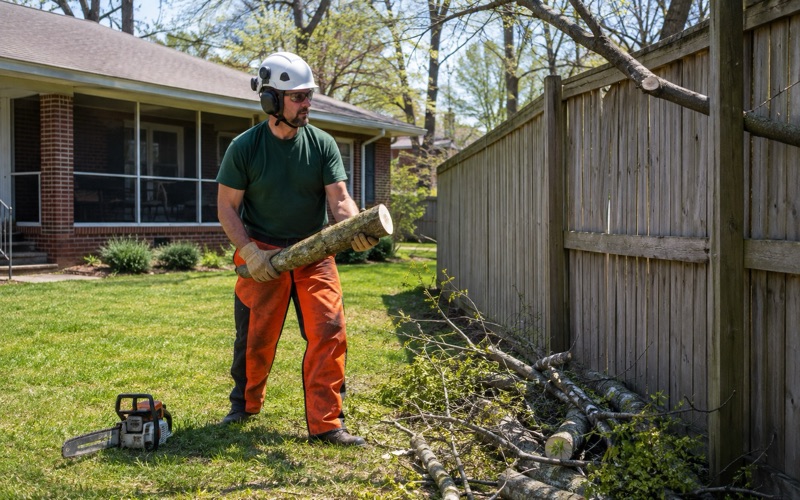
Curbside rules are part of that record too, by their absence. The limb caps, cubic-yard limits and contractor-debris exclusions written into each city’s own collection policy around Decatur do not reach inside this boundary, so our quote states the disposal route in words rather than assuming a municipal program will absorb it. The firewood credit is quoted the same honest way: it is worth least where a county gate takes yard debris free and most where the gate will not accept a log over six inches at any price.
Twenty years of work across three genuinely different kinds of ground in this valley is what makes the portfolio version of this job routine for us: the bottomland at Wheeler Lake, the Highland Rim uplands behind it, and the plateau ground south toward Brindley Mountain. This installation, with more than 75 tenant agencies on it and a residential footprint owned by one operator, simply asks for the same trade organized around one signature instead of three hundred.
- 20+ Years in the Tennessee Valley
- Free Written Estimates
- Same-Day Storm Response