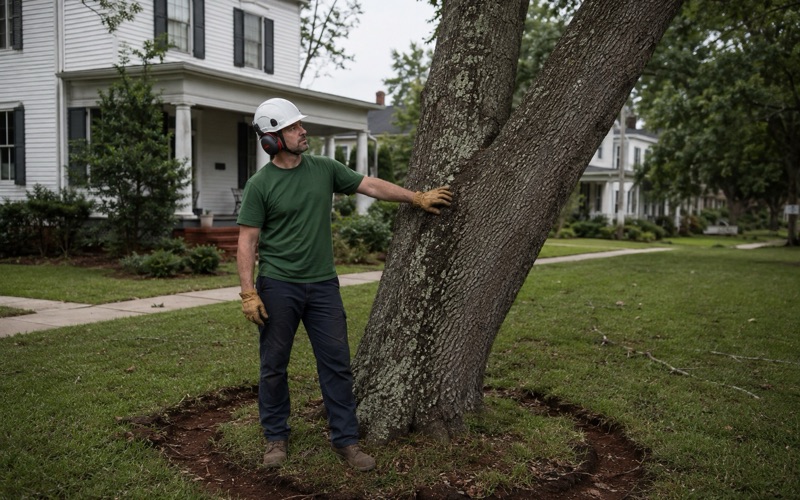
Decatur Tree Removal Pros has been doing tree removal in Triana for more than twenty years, and on a great many jobs in this town the hardest question is not the tree. It is where the tree is allowed to land.
Triana is a town still under construction, and that changes the job in a specific way. The parcel next to the one we are working is frequently an open build site carrying a poured foundation, a stack of delivered material and somebody else’s crew, which means the limiting factor on the removal is not the tree and not the gate — it is the drop zone.
So we measure the drop zone before we price the tree. Gate width, carry distance to the truck, where a chipper that will never fit through a back-yard gate is actually going to sit, and what is standing, parked or curing on the ground a stem would otherwise be dropped onto. Those four answers move the price of a Triana removal far more than the species or the trunk diameter does.
Where a tree can actually land on a street that is still going in
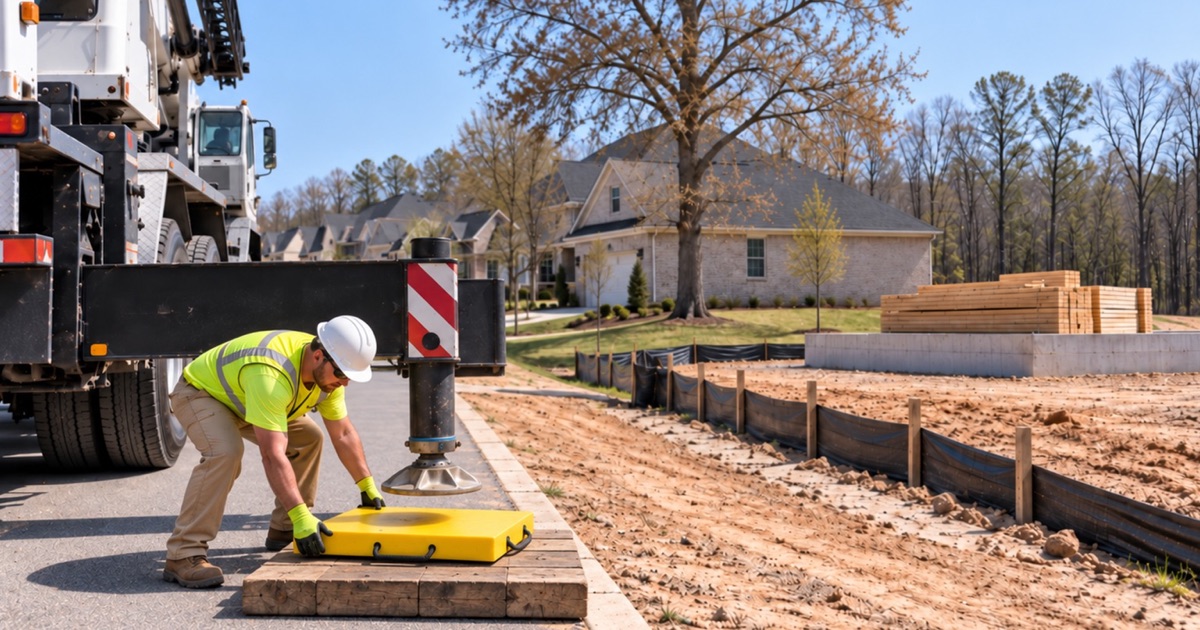
On a finished street the drop zone is a settled question. The lawn is the lawn, the neighbor’s fence has been in the ground for a decade, and a competent faller reads the whole thing from the driveway in about four minutes. A street that is still going in does not hold still that way. What was open ground when the estimate was written can be a footing trench, a slab pour or a lumber drop by the morning our crew arrives.
That is the ordinary condition here rather than the exception. The Town of Triana’s own development page lists six subdivisions with lots still available and two more under construction, and ACS 2024 five-year estimates put 60.7 percent of the town’s housing units in the 2010-or-later bracket. Roughly 89 percent are one-unit detached, so nearly everything we take down stands on a single-family lot with construction finished, half finished or not yet started on at least one side of it.
Reading the lot next door, not just the tree
We walk the adjoining parcels before we write a number. An open foundation is not a drop zone at any price. Neither is a graded pad with rebar tied on it, and neither is a stack of sheathing under a tarp that would cost more to replace than the removal.
What matters is not whether the neighboring lot looks empty from the street. It is what is on it, what is scheduled onto it for the day we are booked, and whether anybody will be standing on it while wood is in the air.
Where the tree really is the easy part
Triana’s lower-density residential districts carry generous minimum lot areas — 21,800 square feet in the R-5 district against 7,500 in R-3 — and on the larger of those a straightforward removal stays a straightforward removal. The constraint tightens as the density does.
On a compact new-build lot with a shell going up behind it, an eighty-foot water oak with room in three directions and none at all in the fourth is a rigging job, not a felling job. Pricing it as a felling job is how a quote comes in low on paper and finishes high on the day.
Looking for tree-removal closer to Athens? See Athens Tree-Removal.
Staging, crane setup and access alongside construction traffic
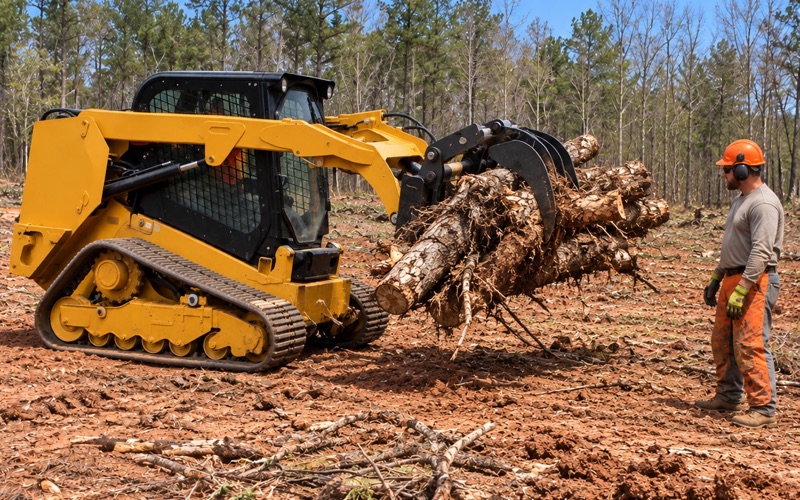
A removal is not only the tree. It is a truck, a chipper, sometimes a grapple truck, and on the harder jobs a crane or a tracked lift — every one of which needs somewhere to be, on a street that may be carrying a concrete truck, a lumber delivery and two subcontractor pickups the same morning.
Where the machines actually sit
Access is measured before the tree is priced: gate width, the drop zone itself, carry distance from the stem to the truck, and the chipper’s parking spot. On a new street the answer is frequently not the driveway, because the driveway is where the framing crew parks. We would rather settle that at the estimate than negotiate it at 7:00 a.m. with a mixer idling behind us.
Crane and lift work over a finished house
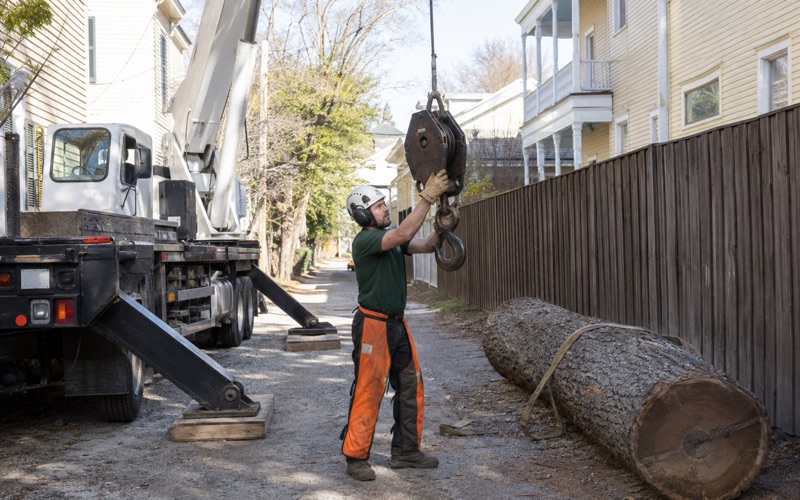
For a tree standing over a roof we quote a crane or a tracked spider lift, and we quote the machine that will actually fit rather than the one in the brochure. A crane wants level ground, sound outrigger footing and a clear swing, and a street in the middle of construction hands out none of the three freely.
A tracked lift will go through a fenced back yard no aerial bucket truck can reach, which on a tight lot is often the difference between a rigging job and a job nobody can do. Which machine the job takes is settled on the walk-through, not discovered on the morning.
Locates before the grinder, on ground this new
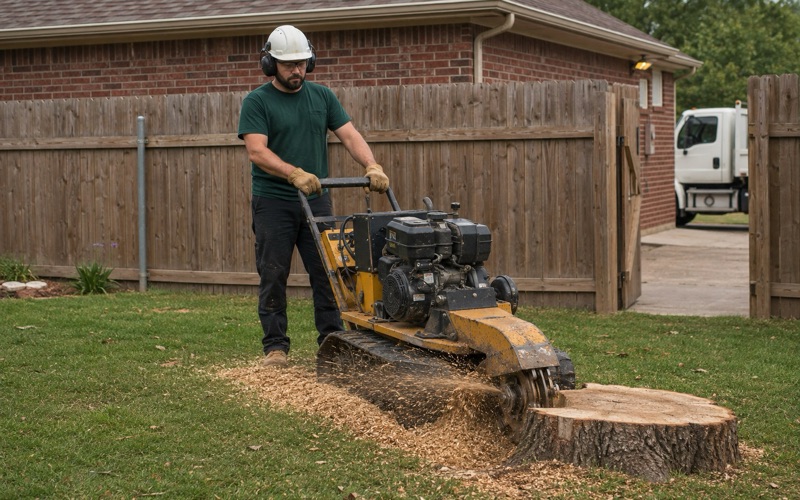
Alabama 811 has to be notified before a stump grinder or a root excavation starts, and on recently built ground that is not a formality. A street finished in the last few years carries service runs that are shallow, freshly trenched and not always where anyone expects them. The Town of Triana runs its own water and sewer systems and maintains its own roads and streets, while Huntsville Utilities supplies the electric and gas, so more than one owner’s plant can cross a single front yard.
What the soil does to grinding depth
The ground here is the Limestone Valleys and Uplands soils of north Alabama — Decatur and Dewey on the valley floor, Bodine on the cherty uplands — with bedrock well beyond five feet in all three. Grinding depth is therefore a machine-class question rather than a rock question: a cutting wheel’s rated 12 to 25 inches below grade stops the job long before stone does. On Bodine ground the chert content shows up as carbide tooth wear, not as refusal.
Rigging a stem down when there is nowhere to drop it
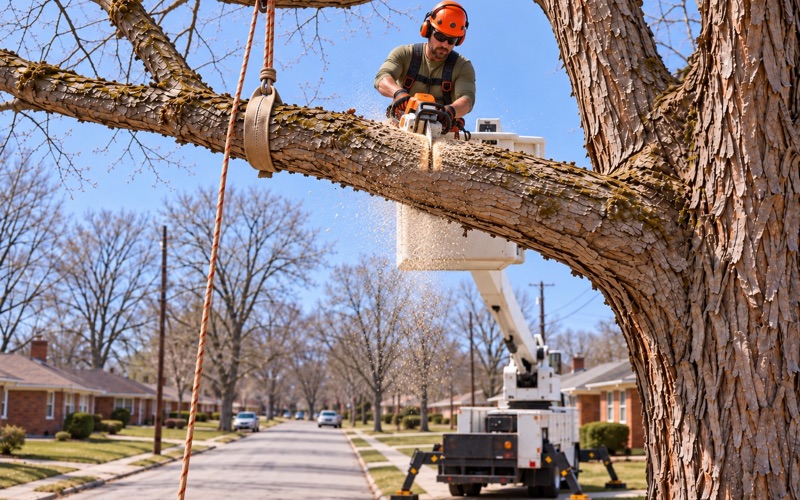
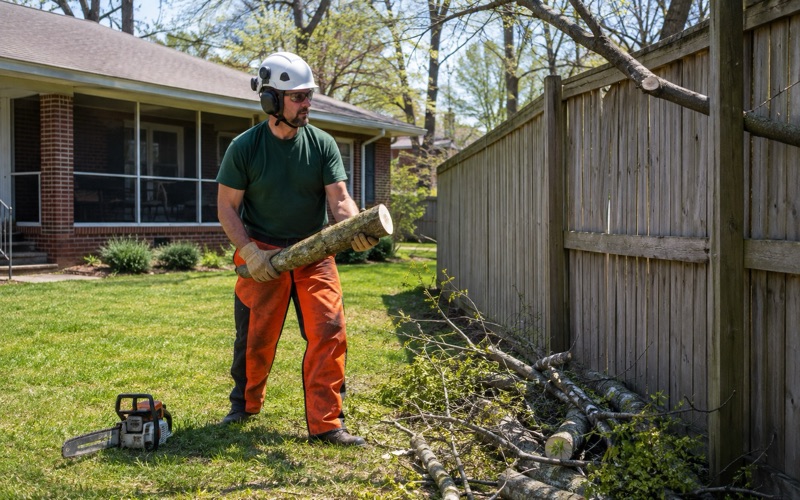
Sectional dismantling is the technique a constrained drop zone actually calls for. The tree comes apart from the top in pieces small enough to control, each one lowered on a rigging line instead of dropped. It is slower than felling and it costs more, and on a lot hemmed in by an active build it is usually the only honest way to do the work.
Pieces sized to the landing, not to the saw
Piece size is set by what the landing will absorb and what the rigging will hold, never by what the saw will cut. A rigging block at a sound union, a bull rope kept inside its working load limit and a Port-a-Wrap friction device at the base let a groundsman run each piece and stop it where it has to stop.
Where there is no landing at all, speed line rigging carries the wood laterally to whatever patch of open ground the property still has, rather than dropping it into a zone that has a foundation in it. That setup takes longer to build than it does to use, and it is on the estimate as its own time.
Working over a roof with an unfinished house behind it
The awkward geometry in Triana is the one where the house we are protecting is finished and the thing behind it is not. A framed shell with no sheathing on it does not read as an obstacle from the ground and takes a falling limb about as well as a greenhouse.
We treat it as a structure, plan the swing away from it, and put that in writing before the first cut. The same goes for a driveway poured last week, which is a surface no grapple truck should be sitting on.
The wire between the pole and the house
The service drop from the pole to the weatherhead gets a straight answer from us, because the utilities around this valley do not all give the same one. Huntsville Utilities’ published position is that clearing trees away from customer service wires is the customer’s responsibility, and its line clearance department takes calls at 256-535-1224.
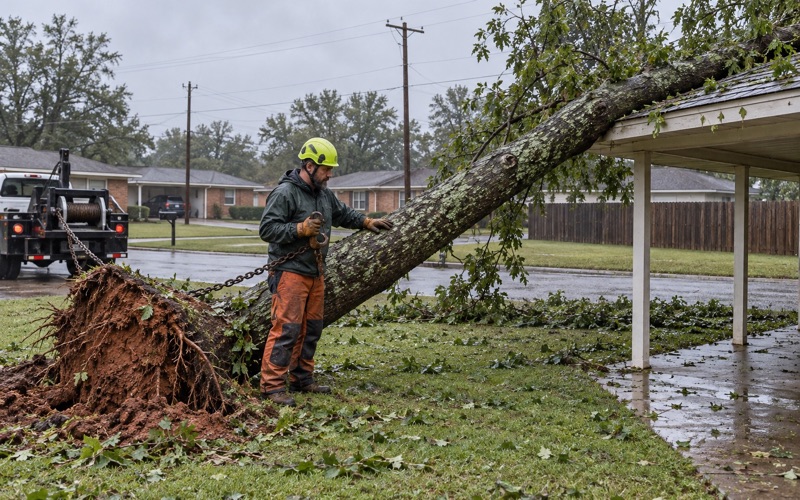
ANSI Z133, the industry safety standard for arboricultural operations, also puts plain limits on working near energized conductors during high wind, ice and thunderstorms. We hold to those limits on a same-day storm call exactly as firmly as on a scheduled removal, and we say which part of a job has to wait rather than pretending it does not.
What gets agreed before a saw starts, and where the wood goes
The conversation with the site next door
Where our work zone touches an active build, the arrangement is made in advance and in specifics: which hours the drop zone belongs to us, where their material moves for the day, whose crew is off the lot while stems are in the air, and who gets the phone call if a schedule slips.
The builder beside us is working under a state land-disturbance permit — construction disturbing an acre or more in Alabama, and smaller sites inside a common plan of development or sale, are covered by an ADEM general permit rather than by anything the town issues — and the silt fence and inlet protection that permit requires are not ours to drive a grapple truck through.
Debris has no free ride out of Triana
Madison County Waste Control and Recycling collects household garbage and large items for the town, and the county is explicit that it does not pick up debris generated by contractors: a resident who hires someone for yard work is told the contractor removes it. The county’s large-debris pages name tree stumps first among the items not collected, cap green-waste limbs at under 8 feet in length, and assess a service charge above a standard load.
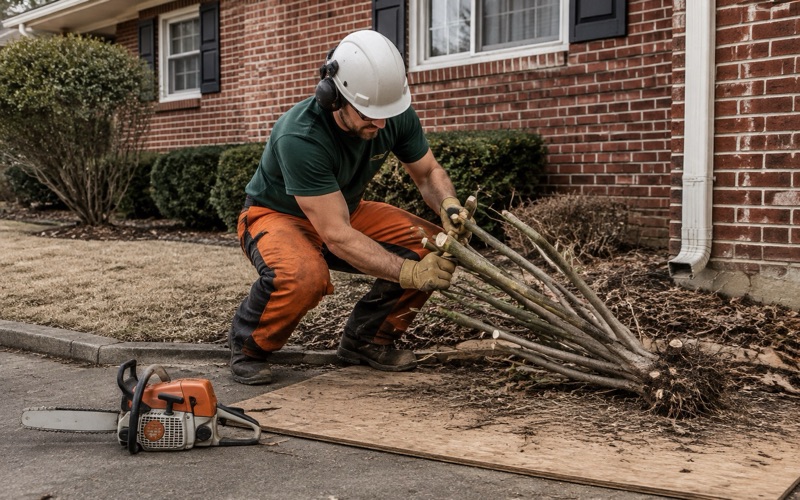
There is no free municipal route for a removal’s wood here. Haul-away is a real priced line on a Triana job, and any quote that leaves it unstated has left money out of the total rather than out of the work.
Three numbers, stated separately
Our estimate splits the takedown, the stump and the debris, because those are the three figures competing quotes disagree about. Haul-away is written on the quote in words — included or not included — so a cheap number and an expensive number can be compared honestly.
The firewood credit is quoted the same way instead of being offered as a favor. It is worth least where a county gate takes yard wood free and most where a county will not take a log at any price, and Triana sits far nearer the second case than the first. That is the whole reason we put it in figures on the page rather than in a sentence on the phone.
- 20+ Years in the Tennessee Valley
- Free Written Estimates
- Same-Day Storm Response